
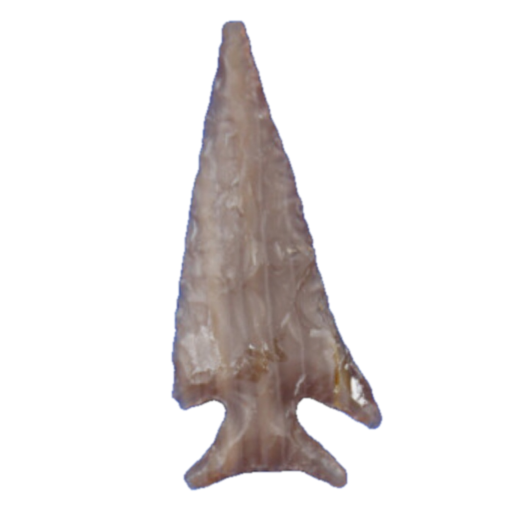
Arrowhead type
Edwards Point
Edwards4,000 - 2,500 B.P.Middle Archaic to Late ArchaicKey facts
- Age
- 4,000 - 2,500 B.P.
- Cultural period
- Middle Archaic to Late Archaic
- Size
- Small to Medium
- Shape
- Notched to Bifurcated
- Glacial period
- Late Holocene
More from the Archaic period
Description
An Edwards point is a medium-sized, finely made, bifacial projectile point characterized by parallel to slightly excurvate blade edges, a narrow stem or contracting base, and well-controlled pressure flaking. The blade is often slender and symmetrical. Edwards points were used as dart points during the Middle to Late Archaic. Many specimens show careful craftsmanship, reflecting the high-quality chert available in the region. Reworked or resharpened examples often retain the narrow blade profile typical of the type.
Size
Lengths typically range from 4 to 8 cm (1.5 to 3 inches). Width generally ranges from 1.8 to 3 cm (0.75 to 1.25 inches). Thickness is usually 0.4 to 0.8 cm. Blades are narrow and straight to slightly convex. Stems are either straight or slightly contracting, with bases that may be straight, slightly convex, or lightly concave. Edges often show fine pressure flaking and high-quality workmanship. The cross-section is lenticular, reflecting careful thinning. Many examples are made from Edwards chert, known for excellent flaking properties.
Distribution
Edwards points are widely distributed across central, southern, and western Texas, with the highest frequencies in the Edwards Plateau, Hill Country, Balcones Escarpment, and adjacent Plains regions. They also occur in northern Mexico and parts of Oklahoma. Their distribution corresponds closely with Edwards Plateau chert quarries and with Archaic hunting camps throughout central Texas.
Additional information
Edwards points are closely tied to the high-quality chert deposits of the Edwards Plateau, which supplied raw material for extensive regional tool production. They often appear in large numbers at quarry and workshop sites, reflecting intensive knapping activity. Edwards points show refined pressure flaking, often with parallel edge retouch. They were part of a broader Archaic toolkit that included Clear Fork gouges, drills, scrapers, and large knives. Their sleek, narrow shape makes them easy to distinguish from other Texas point types such as Nolan or Bulverde.