
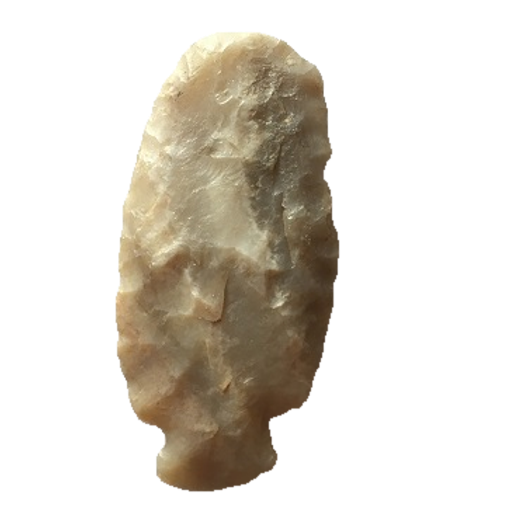
Arrowhead type
San_Pedro Point
San_PedroSan Pedro Cluster3,000 - 1,700 B.P.Late Archaic to Transitional Archaic13 reference photos
Key facts
- Age
- 3,000 - 1,700 B.P.
- Cultural period
- Late Archaic to Transitional Archaic
- Culture
- Cochise Culture
- Size
- Small to Medium
- Shape
- Expanding Stem to Corner Notch
- Material
- Obsidian
- Glacial period
- Neoglacial to Roman Warm
More from the Archaic period
Description
This triangular point exhibits a medium to small size profile, characterized by a stem that expands outward from the blade. In cross-section, the point's shape can range from a flattened profile to a more elliptical one. The blade itself displays a varied curvature, spanning from a pronounced excurvate shape to a straight edge. The shoulders of the point can exhibit a subtle barbing or a gentle upward incline. Notably, the blade features wide, curving notches that originate from the corners, creating an expanding stem and imparting a distinctive corner-notch or expanding-stem morphology. These notches also form a broad neck, separating the blade from the base. The basal edge is typically convex in shape, although it can occasionally appear straight. The hafting area lacks grinding on both the basal and lateral edges. The flaking pattern observed on this point is random, lacking a discernible order or sequence.
Size
The arrowheads exhibit the following dimensional characteristics: their overall length ranges from 30 to 80 mm, with a typical span of 40 to 60 mm and a mean length of 47 mm. The stem portion measures between 7 and 18 mm in length, averaging 10 to 14 mm with a mean of 11 mm. The blade width varies from 15 to 35 mm, commonly falling within the 20 to 25 mm range and averaging 21 mm. The neck width is between 10 and 22 mm, typically averaging 12 to 15 mm with a mean of 14 mm. The basal width of the arrowheads spans 15 to 35 mm, with a mean measurement of 18 mm. On average, the thickness of these artifacts is 7 mm.
Distribution
This type is mainly discovered in the four corners area and across the southwest territory. These artifacts are located on the Uncompahgre Plateau of Colorado, the Rio Puerco of northwestern New Mexico and throughout much of Arizona. This type is discovered with less regularity into southern Arizona
Mainly found in
Additional information
In the realm of Native American arrowhead studies, a particular point style has been identified and referred to by multiple names, including En Medio, Basketmaker II, and Hueco. These designations may indicate a shared technological foundation with subtle regional variations. Notably, the Hueco and Basketmaker II points are characterized by a distinctive combination of features, including a wider, thinner blade, wide notches, and a narrow neck. In contrast, points discovered at the same sites with slightly narrower blades are often classified as San Pedro points, highlighting the nuanced differences within this point style. Despite these stylistic variations, the underlying technology remains consistent, as observed by Justice in 2002.
The En Medio designation was first applied by Cynthia Irwin-Williams to points unearthed at the En Medio shelter in New Mexico. These points have also been linked to the Basketmaker II cultural complex. Interestingly, smaller examples of this point style, associated with the Basketmaker III period, were categorized by Irwin-Williams as Trujillo points. This classification underscores the complexities of point typology and the need for careful consideration of regional and temporal variations. By examining the stylistic attributes and technological characteristics of these points, researchers can gain a deeper understanding of the cultural and historical contexts in which they were created.
The study of these point styles offers valuable insights into the lives and traditions of Native American communities, particularly during the Basketmaker II and III periods. The shared technological foundation and subtle regional variations observed in these points suggest a complex network of cultural exchange and innovation. As archaeologists continue to investigate and analyze these point styles, they may uncover new information about the social, economic, and environmental factors that shaped the lives of these ancient communities. By exploring the nuances of point typology and technology, researchers can reconstruct a more detailed and nuanced picture of Native American history and culture.
Identified by
- Year
- 1965
- Type site
- Bat Cave, New Mexico
Similar types
Types that are easy to confuse with the San_Pedro point.
Other types in the San Pedro Cluster
- En Medio
- Hueco