
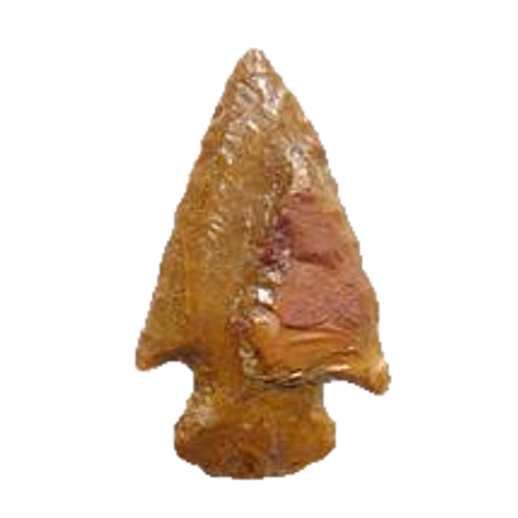
Arrowhead type
Rose Spring Corner Point
Rose Spring CornerRosegate Cluster1,500 - 700 B.P.Late Prehistory to Developmental9 reference photos
Key facts
- Age
- 1,500 - 700 B.P.
- Cultural period
- Late Prehistory to Developmental
- Culture
- Fremont and Anasazi Culture
- Size
- Small
- Shape
- Corner Notch
- Glacial period
- Roman to Medieval
More from the Late Prehistoric, Developmental periods
Description
This triangular corner notch point exhibits a slender profile, characterized by a cross-sectional shape that transitions from flattened to narrowly elliptical. The blade itself is typically thin, with a longitudinal curvature that can range from slightly excurvate to straight-edged. The shoulders of the point are distinguished by barbed edges, which merge into an expanding stem. The basal margin varies in shape, spanning from straight to convexly curved. The flaking pattern observed on this point is random, lacking a discernible or consistent arrangement.
Size
The dimensions of the arrowheads are characterized by the following measurements: overall length ranges from 15 to 60 mm, with a typical average length of 20 to 30 mm. The stem measures between 4 to 8 mm in length. The blade width varies from 8 to 19 mm, while the neck width spans 4 to 9 mm. The stem width is between 6 to 15 mm, and the thickness of the arrowhead is between 3 to 5 mm.
Distribution
This projectile is dispersed across the Great Basin region and extends into the northern section of the Colorado Plateau. Its northern boundary is marked by the Snake River Plain, its eastern edge is defined by the Colorado River valley, its western limit is bounded by Death Valley and eastern California
Additional information
The emergence of the bow and arrow technology in the Great Basin region marked a significant milestone in the evolution of projectile points, with the earliest true arrow points appearing around this time (Justice, 2002). Notably, the Corner Notch, Side Notch, and Stemmed variations of these points may represent a continuum of technological development, rather than distinct types. A key factor distinguishing between the Corner Notch and Side Notch types is the extent of re-sharpening, which can alter the shoulder and notch placement, ultimately maximizing the basal region. In contrast, the Stemmed variation is characterized by a slightly expanding stem, which may be attributed to variations in notching techniques or tool size and sharpness.
The Rose Springs and Eastgate types, initially considered separate entities, were later combined by David H. Thomas (1981) into a single category, known as the Rosegate Cluster, due to their overlapping characteristics. This point type bears similarities to the Eastgate point, but lacks the distinctive square barbs typically associated with the latter. Additionally, the Rosegate point tends to be narrower than its Eastgate counterpart. Both types are believed to have evolved from the Elko Corner Notch type, adapting to the shift from dart points to arrow points. This technological transition ultimately led to the development of new point types, such as the Desert series and Cottonwood points, which eventually replaced the earlier forms (Justice, 2002).
The significance of these point types lies in their representation of a critical period in the development of bow and arrow technology in the Great Basin region. The variations in notching techniques, stem expansion, and overall morphology reflect the experimentation and innovation that occurred during this time. As such, the study of these point types provides valuable insights into the technological and cultural adaptations of the region's indigenous populations, highlighting the complex and dynamic nature of their material culture. By examining the characteristics and evolution of these point types, researchers can gain a deeper understanding of the historical context and cultural significance of these artifacts, shedding light on the lives and traditions of the people who created them.
Identified by
- Named by
- Robert F. Heizer and Martin A. Baumhoff
- Year
- 1961
- Type site
- Rose Springs Site, Owens Valley, California
Similar types
Types that are easy to confuse with the Rose Spring Corner point.
- Columbia Plateau
- Dolores
- Elko
- Priest Rapids
- Rattlesnake
- Snake River
- Stockton
- Wendover
Other types in the Rosegate Cluster
- Eastgate Expanding Stem
- Eastgate Split Stem
- Parowan Basal Notch
- Rose Springs Corner Notch
- Rose Springs Side Notch
- Rose Springs Sloping Shoulder
- Rose Springs Stemmed