
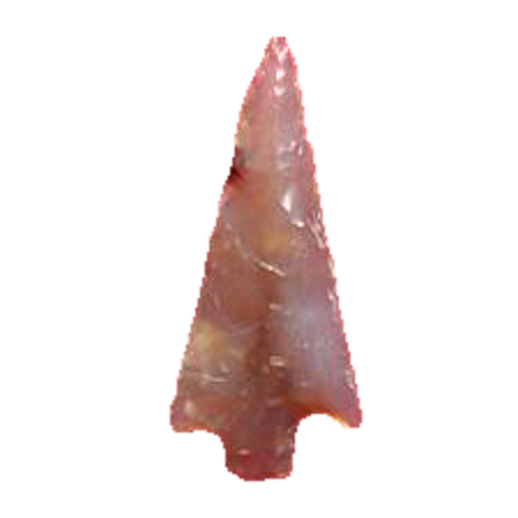
Arrowhead type
Rose Springs Stemmed Point
Rose Springs StemmedRosegate Cluster1,500 - 700 B.P.Late Prehistoric to Developmental26 reference photos
Key facts
- Age
- 1,500 - 700 B.P.
- Cultural period
- Late Prehistoric to Developmental
- Culture
- Fremont and Anasazi Culture
- Size
- Small
- Shape
- Straight Stem to Contracting Stem to Expanding Stem
- Glacial period
- Roman to Medieval
More from the Late Prehistoric, Developmental periods
Description
This triangular corner notch point exhibits a slender profile, characterized by a cross-sectional shape that ranges from flattened to elliptical. The blade itself is typically slender, with a longitudinal curvature that can be either gently excurvate or straight. The shoulders of the point display variability, ranging from pronounced barbs to a more horizontal orientation. The stem tapers outward slightly in most cases, although some specimens may have a straight stem. The basal edge of the point can be either straight or convexly curved. The flaking pattern observed on this point is random, lacking a consistent or deliberate arrangement of flakes.
Size
The arrowheads exhibit a range of dimensions, with overall lengths spanning 15 to 60 mm, typically averaging between 20 to 30 mm. The stem section measures 4 to 8 mm in length, while the blade itself ranges from 8 to 17 mm in width. Conversely, the stem width is narrower, falling within the 4 to 8 mm range. In terms of thickness, these arrowheads are between 3 to 6 mm.
Distribution
This type is discovered extensively across the Great Basin region and extends into the northern section of the Colorado Plateau. Its northern limit is marked by the Snake River Plain, its eastern edge is defined by the Colorado River valley, its western edge is bounded by Death Valley and eastern California
Additional information
The emergence of the bow and arrow technology in the Great Basin region marked a significant milestone in the evolution of projectile points, with the earliest true arrow points appearing around this time (Justice, 2002). Notably, the Corner Notch, Side Notch, and Stemmed variations of these points may represent a continuum of technological development, rather than distinct categories. A key factor distinguishing between the Corner Notch and Side Notch types is the extent of re-sharpening, which can alter the shoulder and notch placement, ultimately maximizing the basal region. In contrast, the Stemmed variation is characterized by a slightly expanding stem, with the degree of expansion potentially influenced by factors such as notching accidents or the size and sharpness of the notching tool.
The classification of these points has undergone refinement over time. David H. Thomas (1981) proposed combining the Rose Springs and Eastgate types into a single category, dubbed the Rosegate Cluster, due to the significant overlap in their characteristics. This reclassification highlights the complexities of point typology and the need for nuanced understanding of the relationships between different point styles. The Rosegate point, in particular, bears similarities to the Eastgate point, although it lacks the distinctive square barbs typically associated with the latter. Additionally, Rosegate points tend to be narrower than their Eastgate counterparts. Both types are believed to have evolved from the Elko Corner Notch type, adapting to the shift from dart points to arrow points in response to changing technological demands.
The eventual replacement of these point types by Desert series points and Cottonwood points (Justice, 2002) underscores the dynamic nature of technological development in the Great Basin region. The Rosegate point, with its unique characteristics and position within the broader context of projectile point evolution, offers valuable insights into the lives and adaptations of Native American communities during this period. By examining the design, manufacture, and use of these points, archaeologists can reconstruct the technological, social, and cultural contexts in which they were created, providing a richer understanding of the region's rich cultural heritage.
Identified by
- Named by
- Robert F. Heizer and Martin A. Baumhoff
- Year
- 1961
- Type site
- Rose Springs Site, Owens Valley, California
Similar types
Types that are easy to confuse with the Rose Springs Stemmed point.
- Alkali
- Columbia Plateau
- Rabbit Island
- Stockton
- Wallula Gap
Other types in the Rosegate Cluster
- Eastgate Expanding Stem
- Eastgate Split Stem
- Parowan Basal Notch
- Rose Springs Corner Notch
- Rose Springs Side Notch
- Rose Springs Sloping Shoulder