
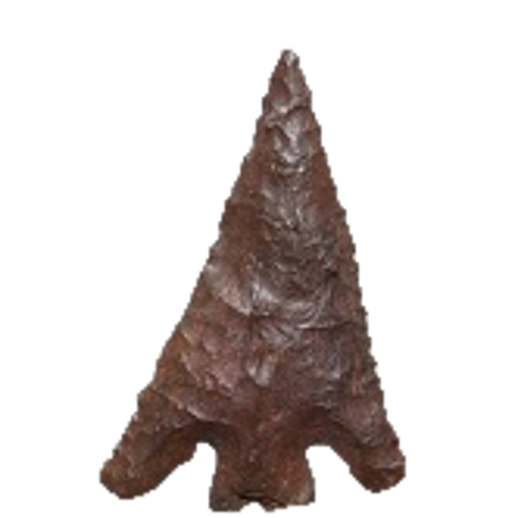
Arrowhead type
Eastgate Split Stem Point
Eastgate Split StemPinto Cluster1,500 - 1,100 B.P.Late Prehistory to Developmental2 reference photos
Key facts
- Age
- 1,500 - 1,100 B.P.
- Cultural period
- Late Prehistory to Developmental
- Culture
- Fremont, Anasazi , Shoshone Culture
- Size
- Small to Medium
- Shape
- Basal Notch to Bifurcated
- Glacial period
- Roman Warm to Vandal Minimum
More from the Late Prehistoric, Developmental periods
Description
This triangular basal notch point exhibits a distinctive morphology, characterized by a slender profile with a flattened cross-sectional geometry. The blade's curvature can vary, ranging from a subtle excurvate to a more pronounced incurvate shape, and typically broadens at the shoulder edge. The shoulders themselves are barbed, often presenting a squared outline, although re-sharpening can sometimes yield a more pointed configuration. Notably, the barbs often extend downward to the base of the point. The stem's shape can vary, with expanding forms being most prevalent, although straight stems are also observed. A notched or bifurcated base is a characteristic feature of this point type. Overall, the craftsmanship is typically of high quality, with a random flaking pattern evident on the point's surface.
Size
The dimensions of the arrowheads are as follows: they range in overall length from 16 to 61 mm, with a mean length typically falling between 33 and 43 mm. The stem measures between 4 and 6 mm in length. The blade width varies from 14 to 35 mm, averaging between 20 and 25 mm. At the shoulders, the stem width is recorded to be between 5 and 9 mm. In terms of thickness, the arrowheads measure between 3 and 6 mm.
Distribution
This projectile is dispersed throughout the Great Basin region and extends into the northern sector of the Colorado Plateau. Its northern boundary is marked by the Snake River Plain, its eastern edge is defined by the Colorado River valley, its western limit is bounded by Death Valley and eastern California
Mainly found in
Additional information
The emergence of the bow and arrow technology in the Great Basin region marks a significant milestone in the evolution of Native American projectile points. Notably, the Rosegate Cluster, a type designation coined by David H. Thomas in 1981, represents a crucial transitional phase in this development. By consolidating the characteristics of the Rose Springs and Eastgate types, Thomas highlighted the overlapping features of these two point styles. A key distinction between the Rose Springs and Eastgate points lies in the presence of square barbs on the latter, which are typically absent on the former. Furthermore, Eastgate points tend to be wider than their Rose Springs counterparts, with notable differences in notch placement. Specifically, Eastgate points feature notches that originate from the base, thereby preserving the full length of the blade, whereas Rose Springs points have notches that enter the blade at a lower point, resulting in a shorter overall length.
Both the Rose Springs and Eastgate types are direct descendants of the Elko Corner Notch type, adapting to the shift from dart points to arrow points. This evolutionary trajectory is a testament to the ingenuity and resourcefulness of Native American communities in the Great Basin region. As noted by Justice in 2002, the Rosegate Cluster was eventually supplanted by other point styles, including the Desert series and Cottonwood points. The chronology of this point type has been established by Homer and Weder, who dated it to between 500 and 800 A.D., preceding the appearance of the Parowan type point. Interestingly, it is hypothesized that the Rosegate Cluster may have given rise to the Parowan type point, underscoring the dynamic and innovative nature of Native American technological development during this period.
The Rosegate Cluster's significance extends beyond its role as a transitional phase in the evolution of arrow point technology. Its characteristics, such as the distinctive notch placement and presence of square barbs, offer valuable insights into the cultural and technological exchange networks operating within the Great Basin region during this time. As an important component of the region's archaeological record, the Rosegate Cluster continues to inform our understanding of the complex and nuanced history of Native American communities, highlighting the importance of careful analysis and interpretation of material culture in reconstructing the past.
Identified by
- Named by
- Robert F. Heizer and Martin A. Baumhoff
- Year
- 1961
- Type site
- Eastgate Cave, Churchill County, Nevada
Similar types
Types that are easy to confuse with the Eastgate Split Stem point.
- Columbia Plateau
- Elko Split Stem
- Emigrant Springs
- Parowan
- Pinto
- Rose Springs
- Wallula