
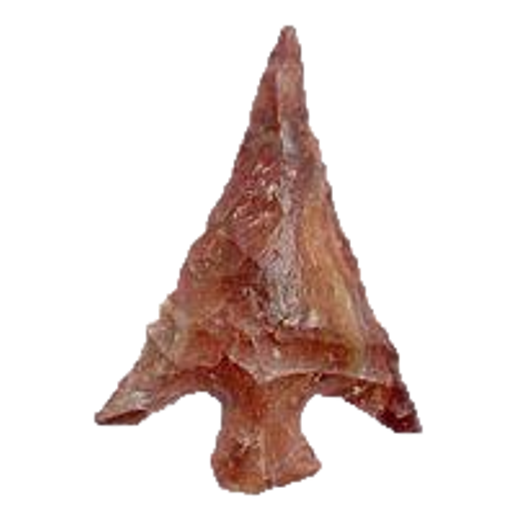
Arrowhead type
Columbia Plateau Point
Columbia Plateau500 - 200 B.P.Classic to Historic17 reference photos
Key facts
- Age
- 500 - 200 B.P.
- Cultural period
- Classic to Historic
- Culture
- Columbia Plateau Culture
- Size
- Small to Medium
- Shape
- Expanding Stem to Straight Stem to Basal Notch
- Glacial period
- Little Ice Age
More from the Preclassic and Classic, Historic periods
Description
This triangular point exhibits a distinctive morphology, characterized by a stem that broadens towards the base, although occasional specimens may display a straight stem. The cross-sectional profile is compressed, lending a flattened appearance to the point. The blade edge is generally straight, yet may exhibit subtle variations, ranging from a slight outward curve to a gentle inward curvature. The shoulders are marked by pronounced barbs, terminating in sharp or pointed tips. The basal edge is variable, spanning a range from straight to gently convex. The flaking pattern observed on this point is random, lacking a discernible order or sequence.
Size
The arrowhead's dimensions are as follows: it measures between 17 and 57 mm in overall length, with a stem length ranging from 4 to 6 mm. The blade's width spans 10 to 19 mm, while the neck width varies between 3 and 6 mm. The basal width is recorded at 5 to 8 mm, and the thickness of the arrowhead falls within the range of 3 to 6 mm.
Distribution
This type is mainly located in the southern areas of the Columbia Plateau, but can also occur with less regularity in the central to northern parts of the Columbia Plateau
Mainly found in
Additional information
More information needed.
Identified by
- Named by
- Douglas Osborne
- Year
- 1952
- Type site
- The Sheep Island site, Chief Joseph Reservoir, Washington
Similar types
Types that are easy to confuse with the Columbia Plateau point.
- Calapooya
- Eastgate
- Gunther
- Hells Canyon
- Merrybelle
- Plateau Horizon Corner Notch
- Priests Rapids
- Quilomene Bar
- Rabbit Island
- Rose Springs
- Wallula