
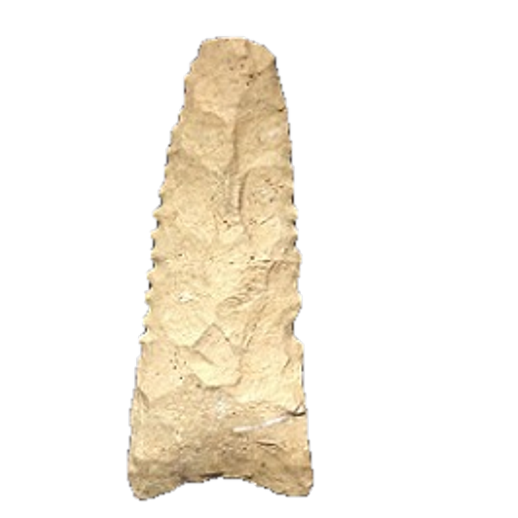
Arrowhead type
Safety Harbor Point
Safety HarborLate Woodland Triangle Cluster to Early Mississippian Triangle Cluster1,100 - 600 B.P.Woodland14 reference photos
Key facts
- Age
- 1,100 - 600 B.P.
- Cultural period
- Woodland
- Culture
- Safety Harbor Culture
- Size
- Medium
- Shape
- Triangle to Lanceolate
- Glacial period
- Vandal Minimum to Little Ice Age
More from the Woodland period
Description
This triangular point exhibits a slender profile, measuring between 1.5 to 2.25 inches in length, with a cross-sectional shape that ranges from elliptical to flattened. The blade's curvature is variable, spanning from slightly excurvate to straight, and often features serrations situated just above the hafting area. Notably, some specimens display a distinctive flare towards the base, imparting an articulated silhouette. The basal corners are characterized by a square morphology, while the base itself is concave in shape. A notable absence of basal grinding is observed, and the flaking pattern appears to be random, lacking any discernible order or consistency.
Size
The dimensions of the arrowheads are characterized by the following measurements: overall length ranges from 40 to 85 mm, with a typical average length of 45 to 55 mm. The width at the base spans 15 to 30 mm, averaging between 22 to 25 mm. The basal concavity, measured at the base, varies from 2 to 7 mm, with an average depth of 4 mm. Additionally, the thickness of the arrowheads falls within a range of 5 to 9 mm.
Distribution
This type is mainly located in the vicinity of Tampa Bay, Florida. It can also be discovered in parts of southern Georgia, southern Alabama, and southwestern South Carolina.
Mainly found in
Additional information
In a notable observation, archaeologist Whatley, in a 2002 publication, proposed an intriguing connection between a specific arrowhead type and the Tallahassee point, a distinct artifact traditionally associated with the region of Georgia. This assertion suggests that the two points may, in fact, be one and the same, highlighting the potential for shared cultural or technological influences across different geographic areas. By drawing this parallel, Whatley's research invites a closer examination of the stylistic and functional characteristics that define these arrowheads, as well as the broader implications for our understanding of Native American cultural exchange and migration patterns during the relevant time period.
Identified by
- Named by
- Gordon R. Willey
- Year
- 1949
- Type site
- Perish Mound I, Manatee County, Florida
Similar types
Types that are easy to confuse with the Safety Harbor point.