
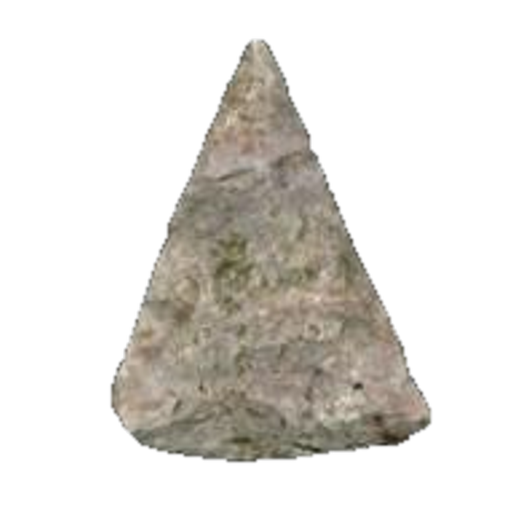
Arrowhead type
Oleno Point
OlenoLate Woodland Triangle Cluster to Early Mississippian Triangle Cluster1,600 - 800 B.P.Late WoodlandKey facts
- Age
- 1,600 - 800 B.P.
- Cultural period
- Late Woodland
- Culture
- Weeden Island Culture
- Size
- Medium
- Shape
- Triangle
- Glacial period
- Roman Warm to Vandal Minimum
More from the Woodland period
Description
This stone tool exhibits a robust, triangular morphology, with dimensions spanning 1.25 to 2 inches in width, and a cross-sectional profile that is elliptical in shape. The blade's curvature varies, ranging from gently excurvate to straight, and its symmetry can be either balanced or asymmetric. A notable feature of this tool is the presence of beveled edges on many specimens, although serrations are consistently absent. The base of the point can exhibit a range of shapes, from straight to mildly convex, without any evidence of basal thinning. The flaking pattern observed on this tool is random and non-patterned. In terms of craftsmanship, the workmanship can vary significantly, with some examples displaying fine, meticulous technique, while others appear more crudely fashioned.
Size
The dimensions of the arrowheads range from 23 to 55 millimeters in overall length, with widths spanning 12 to 28 millimeters, and thicknesses varying between 4 and 12 millimeters.
Distribution
This type is mainly located in the northern parts of Florida, extending into southern Georgia and the southeastern region of Alabama.
Additional information
In the realm of Native American archaeology, a specific type of artifact has garnered significant attention for its unique characteristics and potential uses. These artifacts, often mistaken for knives due to their beveled blades, exhibit a notable asymmetry resulting from repeated sharpening processes, as observed by Granger and Granger in their 2013 study. A key distinction must be made between these points and older, triangular knives, which are frequently confused with one another. According to Bullen's 1975 research, the latter typically present larger and longer profiles, accompanied by asymmetrical blades, whereas the points in question are generally smaller, with symmetrical blades that bear a resemblance to Yadkin points.
A closer examination of these points reveals a crucial difference in their basal morphology, which sets them apart from their Yadkin counterparts. Unlike the concave base characteristic of Yadkin points, these artifacts display a straight to slightly convex base, underscoring the importance of meticulous analysis in archaeological classification. This distinction is not merely a matter of morphological variation but also holds implications for our understanding of the technological and cultural contexts in which these points were produced and utilized. By recognizing and appreciating these subtle yet significant differences, researchers can refine their understanding of the complex and diverse traditions of Native American lithic technology.
The correct identification and interpretation of these points are essential for reconstructing the lives and practices of the cultures that created them. As archaeologists continue to study and learn from these artifacts, they are reminded of the intricate relationships between technological innovation, cultural exchange, and environmental adaptation that have shaped the course of human history. Through a nuanced consideration of the formal characteristics and potential functions of these points, scholars can gain a deeper appreciation for the ingenuity and resourcefulness of Native American communities, ultimately enriching our understanding of the rich and varied heritage of the Americas.
Identified by
- Named by
- Ripley P. Bullen
- Year
- 1958
- Type site
- Six sites near the Chattahoochee River, Florida
Similar types
Types that are easy to confuse with the Oleno point.