
Named stone
Edwards chert
Also called Edwards Plateau chert, Edwards Limestone chert
A kind of chert (and flint)
Edwards chertChert (and flint)Texas & SouthwestDescription
Edwards chert is the chert of the Lower Cretaceous Edwards Limestone in central Texas, a major knappable stone of the Edwards Plateau and nearby country. It occurs as nodules and flat, tabular pieces in the limestone and as rounded pieces in stream and slope gravels. Good stone is patchy: a survey in the lower Bosque basin found usable chert in only 3 of 12 limestone outcrops and 7 of 12 gravel bars. Colours run through grays and browns to purplish tones, often with a pale weathered rind. Prehistoric people quarried it from Paleoindian to Late Prehistoric times and carried it long distances, so Edwards-chert points turn up well outside Texas.
How to identify it
- Colour
- Several grays (light olive gray to grayish black) in the Bosque-basin samples; brownish to purplish at Flint Knob, Travis County.
- Inclusions
- Tiny white to bluish-white microfossils in every Bosque-basin variety; a banded variety with alternating gray tones also occurs.
- Cortex
- A white, weathered rind (cortex) coats pieces at Flint Knob.
- Fluorescence
- Chert from Flint Knob glows a distinct pumpkin colour under fluorescent light, which archaeologists used to trace its spread across a 7,000-acre area. That is a property of that one source, not of all Edwards chert.
Geology
Lower Cretaceous (Comanche Series) Edwards Limestone. Chert occurs in the bedrock as nodules and ledges and as secondary pieces in stream gravels and slope deposits, but it is not present in every outcrop of the limestone.
Where it comes from
Texas & Southwest
States
Quarries and outcrops
- Flint Knob, western Travis County (quarry-workshop on a chert-bearing remnant of the Edwards)
- Lower Bosque basin outcrops and gravel bars (Waco Lake area)
- Edwards Plateau / Hill Country generally
Used by
- Paleoindian through Late Prehistoric: procurement at Flint Knob
- Late Paleoindian: Milnesand points (mostly Edwards chert, some Alibates), per the Library text
Look-alikes
Stones that are easy to confuse with Edwards chert.
- Georgetown chert (a Texas Beyond History page assigns it to the same Edwards Limestone group; collectors treat it as a distinct, high-grade variety)
Sources
- Texas Beyond History (University of Texas at Austin). Flint Knob. Plateaus and Canyonlands section.texasbeyondhistory.net (opens in a new tab)
- Texas Beyond History (University of Texas at Austin). Lithic Raw Materials. Waco Lake / lower Bosque basin pages.texasbeyondhistory.net (opens in a new tab)
- Speer, Charles A. 2014. Experimental sourcing of Edwards Plateau chert using LA-ICP-MS. Quaternary International 342:199-213.doi.org (opens in a new tab)
Points made from this stone
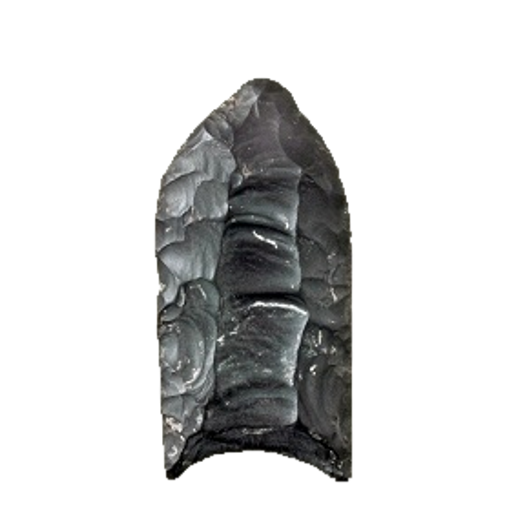 Clovis FlutedEarly Paleoindian13,050–12,750 cal B.P. (Waters et al. 2020)
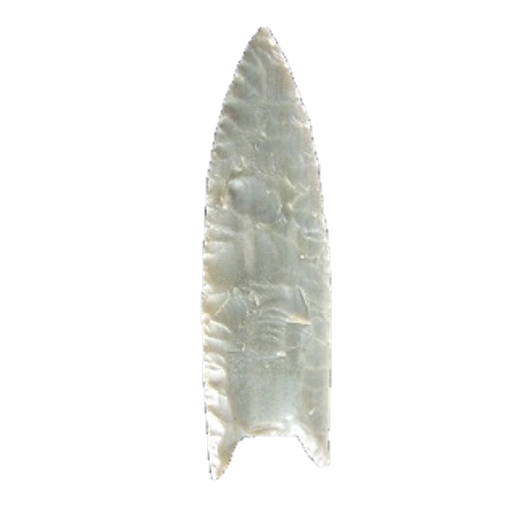 Folsom FlutedPaleoindian10,900–10,200 B.P. (Peck 2011); 11,000–10,500 B.P. in Saskatchewan (Saskatchewan Archaeological Society)
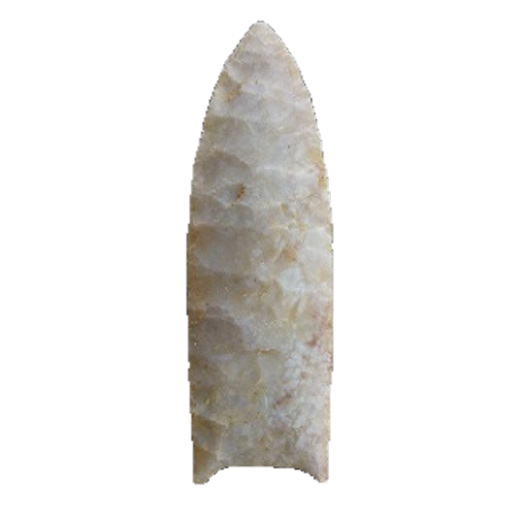 MidlandEarly Paleoindian12,900–12,250 cal B.P. (Texas Beyond History); 11,000–10,000 B.P. (Perino 1971)
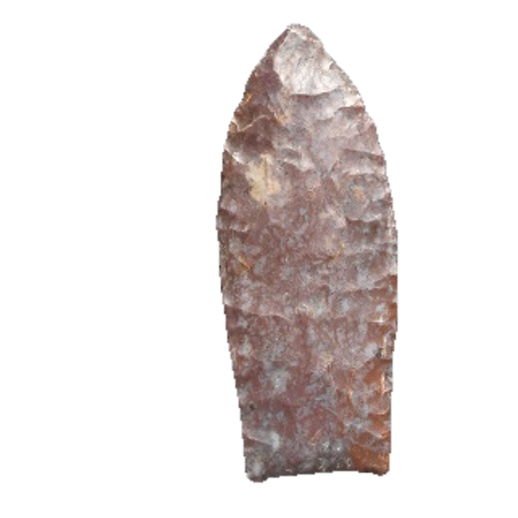 MilnesandLate PaleoAbout 10,000 B.P. (Plainview age; the type site itself has no radiocarbon date)
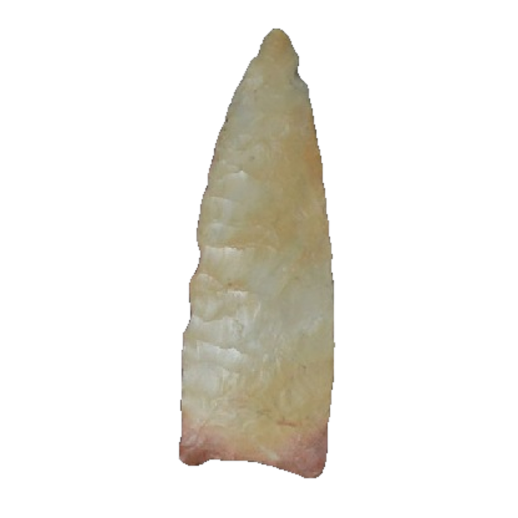 PlainviewLate PaleoindianAbout 12,100 - 11,300 years ago in calendar years (roughly 10,200 - 9,900 B.P. radiocarbon)
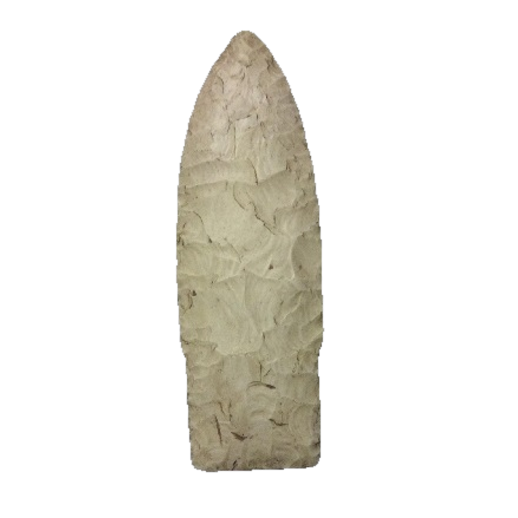 ScottsbluffLate Paleoindian9,900–8,000 B.P. (Cody complex; Knell and Muniz 2013)