
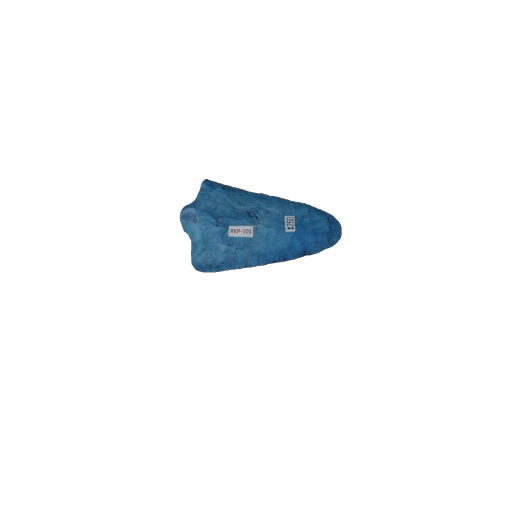
Arrowhead type
Bascom Point
BascomLedbetter Stemmed Cluster4,100 - 3,900 B.P.Late Archaic6 reference photos
Key facts
- Age
- 4,100 - 3,900 B.P.
- Cultural period
- Late Archaic
- Size
- Large
- Shape
- Contracting Stem
- Material
- Quartz
- Glacial period
- Neoglacial
More from the Archaic period
Description
This triangular blade exhibits a distinctive morphology, characterized by a broad, outwardly curved profile and an elliptical cross-sectional shape. Notably, the blade's shoulders are either faint or nonexistent, and when present, they are positioned at an acute, upward inclination. The stem, which is typically short and broad, contracts towards the base, forming a convex termination. Upon closer examination, the flaking pattern reveals a random, uncontrolled sequence of removals, with no discernible evidence of pressure flaking having been applied to the blade's surface.
Size
The arrowheads exhibit the following dimensional characteristics: overall length ranges from 70 to 170 mm, with a typical average length of 80 to 120 mm. The stem portion measures between 11 to 18 mm in length, averaging 9 to 11 mm. In terms of blade dimensions, the width spans 45 to 70 mm, with an average width of 48 to 54 mm. Additionally, the thickness of the arrowheads falls within the range of 8 to 13 mm.
Distribution
This type is mainly located in the southern region of Georgia and extends into southeastern Alabama, northern Florida.
Mainly found in
Additional information
In the realm of Native American archaeology, a specific type of arrowhead has been identified and categorized by various researchers. Notably, Ripley P. Bullen coined the term "Rocker Blades" to describe specimens he discovered in Florida, which he believed shared affinities with Morrow Mountain-related blades. Alternatively, Cambron and Hulse have classified these artifacts as Maples points, as cited in Schroder's 2013 publication (W18). A fascinating aspect of these points is their potential role as preforms, possibly serving as precursors to more refined types, such as Savannah River, Pickwick, and Ledbetter points, as suggested by Schroder in the same 2013 study. This insight highlights the complex and nuanced nature of arrowhead typology, underscoring the need for continued research and analysis to fully understand the technological and cultural developments of Native American societies.
Identified by
- Named by
- James A. Roshto
- Year
- 1983
- Type site
- The Old Bascom (abandoned) settlement, southern Georgia
Similar types
Types that are easy to confuse with the Bascom point.