
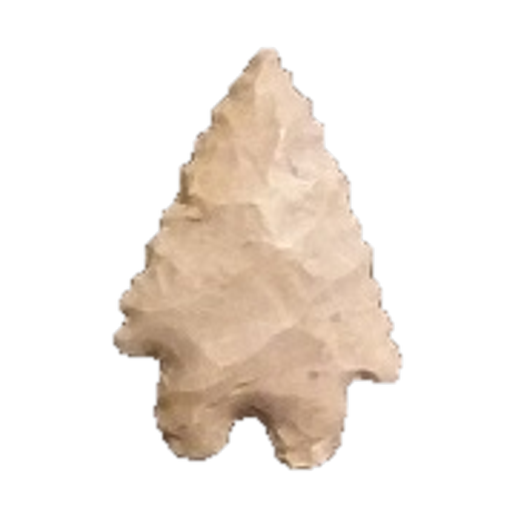
Arrowhead type
LeCroy Point
LeCroyLeCroy Cluster8,500 - 7.800 B.P.Early Archaic27 reference photos
Key facts
- Age
- 8,500 - 7.800 B.P.
- Cultural period
- Early Archaic
- Size
- Small
- Shape
- Straight Stem to Bifurcated
- Material
- Jasper
- Glacial period
- Erly to Middle Holocene
More from the Archaic period
Description
This triangular point exhibits a slender profile, typically measuring between 1 to 1.5 inches in length, with a cross-sectional shape that is elliptical in outline. The blade itself is relatively short and compact, often displaying a straight trajectory, although some specimens may exhibit a subtle excurvate or incurvate curvature, particularly on re-sharpened examples. Serrations are a common feature, and the blade's asymmetry is a notable characteristic. The shoulders of the point typically rise at an upward angle, although in some cases, they may be oriented horizontally. Additionally, the shoulder barbs often display irregular or asymmetrical forms. The stem is a prominent feature, frequently comprising between one-third to one-half of the point's overall length, and is characterized by a broad, straight to expanding morphology, terminating in a deeply bifurcated base. The auriculate basal extensions are rounded and angled downward. Evidence of grinding or smoothing in the hafting region is often present, suggesting deliberate preparation for attachment. The flaking pattern on this point is random, resulting from a manufacturing process that employs fine pressure flaking techniques over an initial percussion flaking stage.
Size
The dimensions of the arrowheads are characterized by the following measurements: - Overall length ranges from 19 to 53 mm, with a typical average length of 31 to 41 mm. - The stem length varies between 9 and 17 mm, averaging 11 to 13 mm, which is generally equivalent to one-third to one-half of the total length. - The width of the blade spans 16 to 40 mm, with an average width of 22 to 28 mm. - The neck width measures between 12 and 24 mm, averaging 16 to 19 mm. - At the base of the stem, the width ranges from 14 to 29 mm, with an average of 19 to 23 mm. - The thickness of the arrowheads is between 4 and 9 mm.
Distribution
These artifacts are mainly linked to the Ohio River Basin and extending into the Central Mississippi River Basin, the Tennessee River Basin, and the Piedmont regions of Southern and Northern Carolina and Virginia
Mainly found in
Also found, less often, in
Additional information
In the realm of bifurcated arrowhead types, the LeCroy point stands out as a notable example, characterized by its diminutive size, as observed by Whatley in 2002. This point type is particularly prevalent in the eastern United States, with Broyles' 1971 research identifying it as the most common bifurcated point found in this region. A key distinguishing feature of the LeCroy point is its straight stem, which sets it apart from other similar point types, such as the MacCorkle and St. Albans, which exhibit more lobed bases.
The LeCroy point bears a resemblance to the St. Albans point, although a closer examination reveals distinct differences. One of the primary distinguishing characteristics is the presence of more pronounced shoulders on the LeCroy point, whereas the St. Albans point tends to have weaker or even absent shoulders. This subtle yet significant variation highlights the importance of careful analysis and attention to detail in the identification and classification of arrowhead types.
The LeCroy point's unique combination of characteristics, including its small size, straight stem, and pronounced shoulders, makes it a valuable find for archaeologists and collectors alike. By examining the nuances of this point type, researchers can gain a deeper understanding of the technological and cultural developments of the Native American groups that created these artifacts, ultimately shedding light on the complex and fascinating history of the region.
Identified by
- Named by
- Madeline Kneberg
- Year
- 1956
- Type site
- A. L. LeCroy Site, Hamilton County, Tennessee
Similar types
Types that are easy to confuse with the LeCroy point.
- Fredrick
- Garth Slough
- Jude
Other types in the LeCroy Cluster
- Fox Valley
- Kanawha
- Lake Eerie