
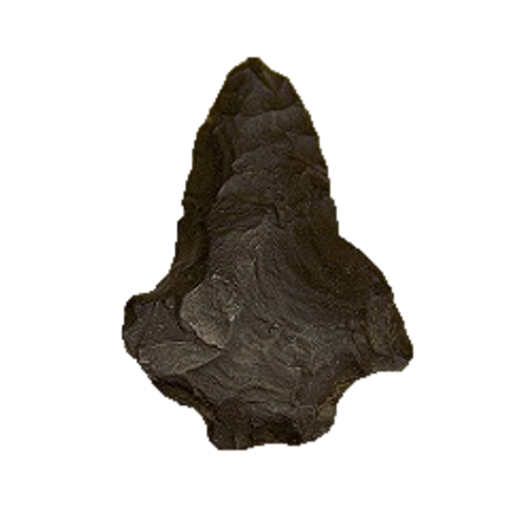
Arrowhead type
Kanawha Point
KanawhaLeCroy Cluster8,200 - 7,800 B.P.Early Archaic12 reference photos
Key facts
- Age
- 8,200 - 7,800 B.P.
- Cultural period
- Early Archaic
- Size
- Small to Medium
- Shape
- Expanding Stem to Bifurcated
- Glacial period
- Middle Holocene
More from the Archaic period
Description
This triangular point exhibits a distinctive bifurcated form, characterized by an elliptical cross-sectional profile that can vary in thickness. The blade's morphology is generally straight, although instances that have undergone extensive re-sharpening may display either an incurvate or recurvate curvature. In such cases, the shoulder edges often exhibit a pronounced flare. Serrations are a common feature along the blade's edge. The shoulders are angled upwards, forming a sloping contour. The stem expands downward, terminating in a bifurcated base. While basal thinning is a frequent occurrence, basal grinding is notably absent. The flaking pattern on this point is random, lacking a discernible pattern or orientation.
Size
The dimensions of the arrowheads are as follows: they range in overall length from 19 to 48 mm, with a mean length typically falling between 30 and 36 mm. The stem measures between 4 and 7 mm in length. The blade width varies from 19 to 37 mm, while the neck width spans 8 to 14 mm. The stem width is between 10 and 15 mm, and the thickness of the arrowhead ranges from 3 to 7 mm.
Distribution
These artifacts are mainly linked to the Ohio River Valley and extending into the coastal area and Northeastern territory. This type can also be discovered in the Tennessee River Valley and Georgia, albeit with lesser occurrence
Mainly found in
Also found, less often, in
Additional information
The evolution of Native American arrowheads is a complex and fascinating topic, with various styles and forms emerging over time. One notable example is the development of the large Stanly Stemmed point, which is believed to have originated from an earlier design (Coe, 1964). This particular point is associated with the Early Archaic period, although some researchers, such as Garner (1989), argue that the introduction of the bifurcated base marks the beginning of the Middle Archaic period. The presence of this point at the St. Albans site, specifically in levels above the LeCroy levels and below the Stanly levels (W10), provides valuable insights into the chronological sequence of archaeological deposits.
A closer examination of the bifurcated base reveals an interesting geographic disparity in its usage. While this base style was eventually abandoned in the southern regions, it continued to be employed in the north for an extended period (Funk, 1993). This phenomenon highlights the regional variations in technological and stylistic developments among Native American cultures. The persistence of bifurcated bases in the north suggests a degree of cultural continuity and tradition, which is an important aspect of archaeological research. By studying the distribution and chronology of different arrowhead styles, researchers can gain a deeper understanding of the complex social and cultural dynamics that shaped the lives of Native American communities.
The study of arrowheads like the Stanly Stemmed point offers a unique window into the lives of ancient cultures, providing clues about their technological, social, and cultural developments. The fact that this point has been dated to the Early Archaic period, with some debate about its association with the Middle Archaic period, underscores the complexities of archaeological chronology. Nevertheless, the analysis of this point and its bifurcated base contributes significantly to our understanding of the regional and temporal variations in Native American material culture, allowing us to reconstruct a more nuanced and detailed picture of the past.
Identified by
- Named by
- Bettye J. Broyles
- Year
- 1971
- Type site
- St. Albans Site, Kanawha County, West Virginia
Similar types
Types that are easy to confuse with the Kanawha point.
- Fredrick
- Garth Slough
- Jude
Other types in the LeCroy Cluster
- Fox Valley
- Lake Eerie
- LeCroy