
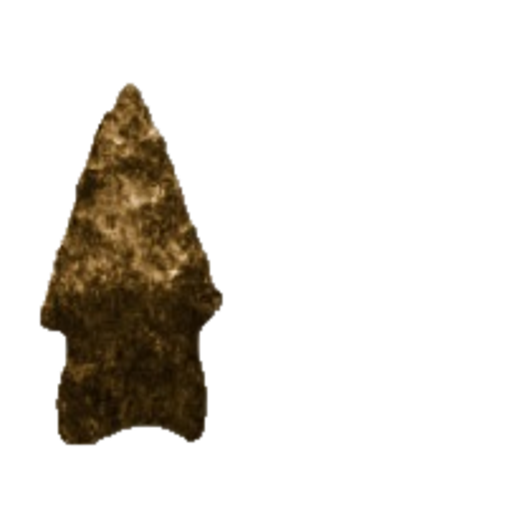
Arrowhead type
Jude Point
Jude9,500 - 9,000 B.P.Transitional Paleo to Early ArchaicKey facts
- Age
- 9,500 - 9,000 B.P.
- Cultural period
- Transitional Paleo to Early Archaic
- Size
- Small
- Shape
- Expanding Stem to Straight Stem to Bifurcated
- Glacial period
- Early Holocene
Description
This triangular stemmed point measures between 0.75 and 1.125 inches in length, exhibiting an elliptical cross-sectional profile. The blade typically presents a straight edge, although occasional specimens may display a subtle excurvate curvature. Serrations may be present on the blade in some instances. The shoulders of this point can exhibit a range of morphologies, from horizontal to distinctly barbed. The stem's shape varies, spanning from slightly expanding to straight, and often approximates the length of the blade. Notably, the stem's width frequently matches or exceeds its length. Many examples display light basal grinding and thinning, which suggests a degree of intentional shaping. The base of this point can assume various forms, including straight, concave, or even bifurcated configurations. The flaking pattern observed on this point is characterized by a random, non-patterned arrangement of flakes.
Size
The arrowheads exhibit the following dimensional characteristics: - Overall length ranges from 10 to 35 mm, with a mean length of 24 mm. - The stem measures between 10 and 12 mm in length, averaging 11 mm. - Blade width varies from 17 to 23 mm, with an average width of 20 mm. - The width of the stem falls within the range of 13 to 16 mm, averaging 15 mm. - In terms of thickness, the arrowheads measure between 4 and 6 mm.
Distribution
This type is mainly located in the Tennessee River valley and its surrounding waterways. It can also be discovered, albeit less often, in the central regions of Virginia, North Carolina, and South Carolina
Mainly found in
Also found, less often, in
Additional information
In the realm of Native American arrowhead studies, the Cave Springs point bears a striking resemblance to the Jude point, with a key distinguishing feature setting them apart. As noted by Cambron, a notable difference between these two point types lies in the base morphology, where the Cave Springs point is characterized by a bifurcated base. This distinctive basal feature, observed by researchers such as Brookes in 1979, serves as a primary means of differentiating the Cave Springs point from its Jude counterpart. By examining this specific characteristic, archaeologists can gain valuable insights into the technological and cultural nuances of the societies that crafted these arrowheads.
The bifurcated base of the Cave Springs point is a significant aspect of its design, potentially reflecting the functional and stylistic priorities of its creators. As researchers continue to study and compare the Cave Springs and Jude points, a deeper understanding of the historical and cultural contexts in which they were produced can be developed. The work of Brookes in 1979, alongside Cambron's observations, has contributed substantially to our current knowledge of these point types, highlighting the importance of meticulous description and analysis in archaeological research.
Through the examination of subtle differences in arrowhead morphology, such as the bifurcated base of the Cave Springs point, archaeologists can reconstruct a more detailed picture of the lives and traditions of Native American communities. By considering the Cave Springs point within the broader context of Native American archaeological findings, researchers can shed light on the complex and varied cultural practices that have shaped the history of the region. As our understanding of these point types continues to evolve, it is likely that new discoveries and analyses will further refine our appreciation of the technological, social, and cultural dynamics at play in the creation and use of these ancient artifacts.
Identified by
- Named by
- Madison - Huntsville Chapter of Alabama Archaeological Society
- Year
- 1961
Similar types
Types that are easy to confuse with the Jude point.
- Cave Springs
- Garth Slough
- Halifax
- Kanawha
- LeCroy
- Limestone
- McIntire
- Rheems Creek
Other types in this cluster
- Big Sandy
- Dalton