
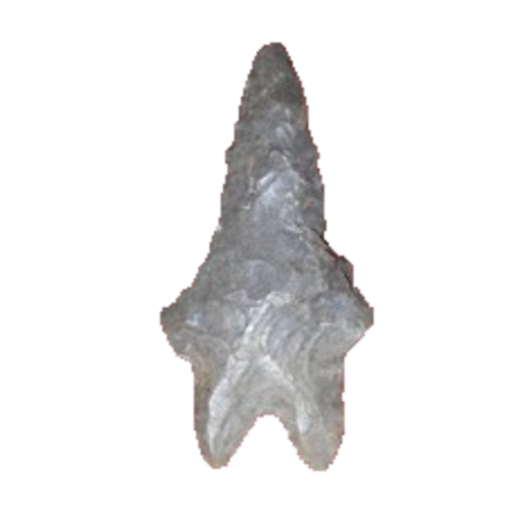
Arrowhead type
Lake Errie Point
Lake ErrieLeCroy Cluster8,300 - 7,800 B.P.Early Archaic18 reference photos
Key facts
- Age
- 8,300 - 7,800 B.P.
- Cultural period
- Early Archaic
- Size
- Small
- Shape
- Straight Stem to Bifurcated
- Glacial period
- Early to Middle Holocene
More from the Archaic period
Description
This artifact presents as a compact, triangular point, distinguished by its bifurcated tip, which assumes an elliptical shape. The blade edge is predominantly linear, with minimal curvature. The shoulders of the point exhibit variability, ranging from a horizontal orientation to a subtle, upward inclination. The stem, which connects the blade to the base, is typically characterized by a straight profile, although some specimens may display a slight contraction or expansion along its length. The base of the point is notable for its bifurcated morphology, comprising two parallel lobes. The flaking pattern observed on this point is random, lacking a discernible, organized sequence.
Size
The dimensions of the arrowheads are as follows: they range in total length from 25 to 50 mm, with stem lengths varying between 9 and 14 mm. The blade width spans 17 to 30 mm, while the stem width measures between 11 and 18 mm, based on a limited dataset.
Distribution
These artifacts are distributed across the Ohio River basin and extend into the Great Lakes area. This type can also be located in southwestern New York
Additional information
In the realm of Native American archaeology, the classification and characteristics of certain arrowhead types have been the subject of ongoing research and debate. Notably, the Lake Erie points, as identified by Justice in 1987, bear a striking resemblance to Fox Valley points, potentially representing an exhausted blade form. Furthermore, Morton's 1973 study suggests that these points may be a variant of the LeCroy point, distinguished by the presence of burination on the shoulder or base. This distinctive feature has sparked interest among researchers, who seek to understand the nuances of these ancient tools.
A closer examination of the Lake Erie Bifurcated points reveals a propensity for fractures or sliver chipping, which can occur in one or more of four specific locations. According to Jay Magella's observations, these fractures tend to appear with decreasing frequency at the shoulder tips, the outside stem edge, the inside of the bifurcation, or across the base. Interestingly, these points may exhibit single or combined fractures in these areas, highlighting the complexity of their manufacture and use. The work of Blank (1970) provides additional context, as he argues that the Lake Erie and LeCroy types, despite their distinct mean quantitative attributes, exhibit overlapping ranges of variation. This overlap is significant, as it suggests that approximately 20% of samples from these point types cannot be definitively classified into one category or the other, as noted by Harter in 1973.
The chronological and cultural placement of these bifurcated point types has been the subject of careful consideration, with researchers seeking to understand their position within the broader context of Native American archaeology. The similarities and differences between the Lake Erie and LeCroy types have important implications for our understanding of the technological, social, and cultural developments of the regions in which they were used. As such, continued research and analysis of these point types are essential for refining our knowledge of the complex and dynamic histories of Native American communities. By examining the characteristics, manufacture, and use of these ancient tools, we may gain a deeper appreciation for the ingenuity, adaptability, and cultural expression of the peoples who created them.
Identified by
- Named by
- Olaf H. Prufer and Charles Sofsky
- Year
- 1965
- Type site
- McKibben Site, Trumbull County, Ohio
Similar types
Types that are easy to confuse with the Lake Errie point.