
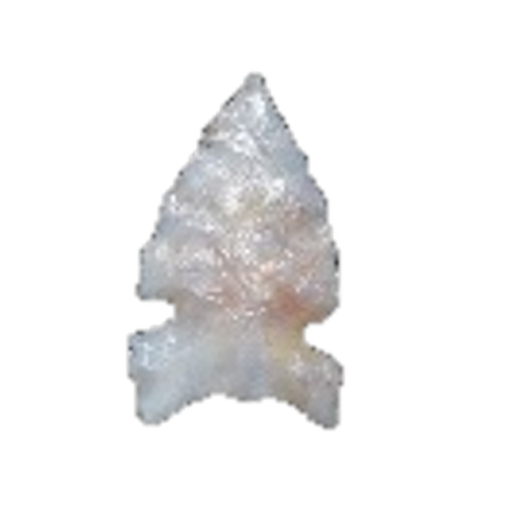
Arrowhead type
Haskell Point
HaskellWashita Cluster800 - 600 B.P.Mississippian8 reference photos
Key facts
- Age
- 800 - 600 B.P.
- Cultural period
- Mississippian
- Culture
- Caddoan Culture
- Size
- Small
- Shape
- Side Notch
- Glacial period
- Medieval Warm
More from the Mississippian period
Description
This lithic specimen exhibits a slender profile, characterized by a compressed cross-sectional morphology. The blade edge is predominantly linear, with a subtle curvature in some instances, and may feature serrations. Notching is an uncommon feature on this point type. When present, notches are typically arranged in a parallel configuration, accompanied by horizontally oriented shoulders and a broadened stem. The basal portion of the point is usually concave, although a straight base is observed in a subset of examples. The flaking pattern is often incomplete, resulting in the retention of the original flake surface, which displays a non-uniform, random arrangement of flake scars.
Size
The dimensions of the arrowheads are characterized by the following measurements: overall length ranges from 15 to 35 mm, while the stem length spans 8 to 11 mm. The width at the shoulders varies between 8 and 15 mm, and the neck width is measured between 5 and 10 mm. Notch depth is recorded at 2 to 3 mm, with notch placement positioned between one-quarter and one-half of the total length from the base. Additionally, the basal width is measured between 12 and 20 mm, as per the standards outlined by Suhm and Krieger (1954).
Distribution
These artifacts are mainly linked to the Caddoan tradition and its subsets in Texas, Oklahoma, and extending into Kansas, Missouri, Arkansas, and Louisiana, as well as into Mexico. These artifacts can also be discovered in neighboring areas, albeit less often. Artifacts beyond the Caddoan cultural sphere may belong to one of the Plains Side Notch categories. Artifacts discovered in the Pueblo Cultural and sub-cultural territories may belong to the Pueblo Side Notch category
Additional information
In the realm of Native American arrowheads, a distinctive type of point can be identified by its concave base, which sets it apart from other similar types, such as the Harrell point, characterized by a center notch on its base. This particular point also bears a resemblance to the Reed point, although the latter features a straight base, highlighting the importance of base morphology in point typology. Furthermore, this type of point shares similarities with Toyah points, but the placement of notches differs significantly, with Toyah points exhibiting notches that enter the blade at a higher position on the preform, whereas this type has notches that are positioned lower.
A notable characteristic of points within this cluster is the presence of side notches, which distinguishes them from points in the Woodland/Mississippian triangular cluster, as observed by Morrow in 1984. Despite this difference, both types of points are renowned for their slender profiles and triangular shapes, often approximating isosceles or equilateral triangles. The blades of points in this cluster frequently feature single or multiple parallel notches, and in some cases, may also be serrated, as seen in the W2 type. This combination of traits underscores the complexity and diversity of Native American arrowhead typology, highlighting the need for careful analysis and consideration of multiple characteristics when identifying and classifying these artifacts.
The presence of parallel notches and serrations on the blades of these points suggests a high degree of craftsmanship and attention to detail, as these features would have required careful planning and execution to produce. The fact that these points are often found in association with other triangular points, such as those in the Woodland/Mississippian cluster, underscores the importance of considering the broader cultural and technological context in which these artifacts were produced and used. By examining the characteristics of these points in conjunction with other archaeological evidence, researchers can gain a deeper understanding of the lives and traditions of the Native American communities that created them.
Identified by
- Named by
- James Brown
- Year
- 1968
- Type site
- Spiro Mounds, Oklahoma
Similar types
Types that are easy to confuse with the Haskell point.
Other types in the Washita Cluster
- Cahokia
- Des Moines
- Washita Peno