
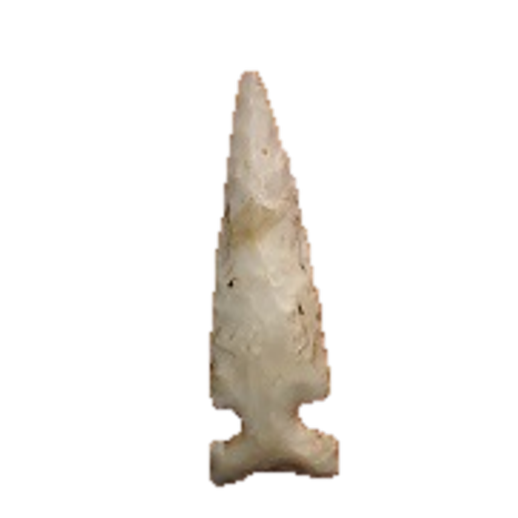
Arrowhead type
Cahokia Point
Cahokia1,100 - 500 B.P.Woodland34 reference photos
Key facts
- Age
- 1,100 - 500 B.P.
- Cultural period
- Woodland
- Culture
- Cahokia Culture
- Size
- Small to Medium
- Shape
- Side Notch
- Material
- Bone
- Glacial period
- Medieval Warm
More from the Woodland period
Description
This point exhibits a slender profile, characterized by a medium-sized dimensions and a flattened cross-sectional shape. The blade itself is predominantly straight, occasionally featuring serrations or notches along one or both edges. A distinctive trait of this point is the presence of parallel notches, although in rare instances, these notches may be absent. The shoulders are marked by a straight alignment, transitioning into an expanded stem. The basal edge, which forms a continuous line with the blade, may display notching and exhibits a gradual expansion laterally. Notably, the parallel notches initiate high up on the blade. The base of the point is generally straight, but can also be concave or notched in some cases. While most examples are crafted from stone, a small number have been fashioned from bone. The manufacturing process involves pressure flaking, resulting in a random flaking pattern, and the overall workmanship is typically of high quality, reflecting a well-executed technique.
Size
The dimensions of the arrowheads are as follows: they range in overall length from 19 to 43 mm, with stem lengths varying between 8 and 11 mm. The width of the blade at the shoulders measures between 7 and 17 mm, while the basal width spans from 11 to 22 mm.
Distribution
This type is mainly linked to the Cahokia Civilization in Illinois and Missouri. Discoveries of these points extend into Indiana, albeit less often. According to the University of Minnesota, they are also present in southeastern Minnesota, eastern Iowa, and southern Wisconsin, notably at the Aztalan Site. Additionally, these points have been identified along Cahokia trade pathways into prominent Caddoan locations, including the Spiro Mounds
Additional information
In the realm of Native American arrowheads, the points within this particular cluster exhibit distinct characteristics that set them apart from others. Notably, the Triple Notch and Multiple Notch varieties are generally associated with the Old Village period, whereas the Double Notch, Serrated, and Un-notched types are more commonly linked to the Trappist period, as observed by Perino in 1968. A key feature of these points is the presence of side notches, which distinguishes them from the Woodland/Mississippian triangular cluster, as highlighted by Morrow in 1984. The points in this cluster are typically thin and triangular in shape, often with a single or multiple parallel notches in the blade, and may also exhibit serration, as seen in the W2 type.
The evolution of these points is marked by the eventual replacement of this type by the Madison point, which shares a similar basic shape but lacks notches, as noted by Justice in 1987. Scully's 1951 classification identifies four distinct variations: Double Notch, Triple Notch, Multiple Notch, and Serrated. Interestingly, Morrow's 2016 research reveals that the more complexly notched varieties have counterparts on the Great Plains, such as the tri-notched Harrell point and the double-notched or multiple-notched Huffaker points. This similarity highlights the potential challenges in distinguishing between these point varieties when found outside of a village site with known Mississippian associations, as they may be difficult to differentiate from their Great Plains counterparts.
The study of these arrowheads provides valuable insights into the cultural and technological developments of Native American communities. The presence of notches and serration on these points suggests a high degree of craftsmanship and adaptability, reflecting the resourcefulness and ingenuity of the people who created them. Furthermore, the distribution of these point varieties across different regions and periods underscores the complex networks of trade, migration, and cultural exchange that existed among Native American groups. As such, the analysis of these arrowheads offers a unique window into the lives and traditions of these communities, shedding light on their technological, social, and cultural practices.
Identified by
- Named by
- Warren Moorehead and Edward G. Scully
- Year
- 1922
- Type site
- Cahokia Mounds site, St. Clair County, Illinois
Similar types
Types that are easy to confuse with the Cahokia point.
- Dane Sharktooth
- Little Sioux
- Plains
- Prairie