
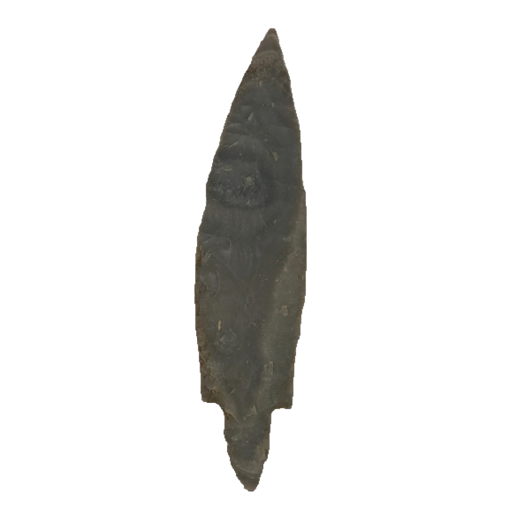
Arrowhead type
Turkeytail Hebron Point
Turkeytail HebronTurkeytail Cluster4,000 - 2,500 B.P.Late Archaic to Early Woodland15 reference photos
Key facts
- Age
- 4,000 - 2,500 B.P.
- Cultural period
- Late Archaic to Early Woodland
- Culture
- Adena Culture
- Size
- Medium to Large
- Shape
- Contracting Stem
- Glacial period
- Neoglacial
Description
This triangular point exhibits a medium to large size range, characterized by a stem that tapers inward. Its cross-sectional profile is notably flattened, occasionally approaching an elliptical shape. The blade's curvature is predominantly excurvate, although some specimens may display a straight-edged configuration. The shoulders slope downward, defined by a sharp, straight margin. The stem's contracting nature is a distinctive feature, while the base varies from pointed to strongly convex. The flaking pattern observed on this point is random, lacking a discernible, organized arrangement.
Size
The arrowheads exhibit a range of dimensions, with overall lengths spanning 50 to 170 mm. The stem, which forms the base of the arrowhead, measures between 16 and 29 mm in length. In terms of width, the blade itself ranges from 23 to 39 mm, while the stem width at the shoulder joint varies between 13 and 30 mm.
Distribution
This type is most abundant in the Ohio River Valley. It can also be located in the Great Lakes area and throughout the Tennessee River valley
Additional information
In the realm of Native American arrowheads, a distinctive variation stands out due to its unique morphological characteristics. Notably, this particular type exhibits a stem that contracts more significantly than its counterparts, setting it apart from other variations within the same cultural context. The relative rarity of this variation adds to its intrigue, making it a fascinating subject for archaeological study.
A comparative analysis reveals that this variation bears a striking resemblance to the Adena Waubesa point, a type of arrowhead associated with the Adena culture. However, a closer examination reveals a key distinguishing feature: the shoulder of this variation is characterized by a straight, downward-angled orientation. This subtle yet significant difference highlights the complexity and diversity of arrowhead designs within Native American cultures, underscoring the importance of meticulous classification and analysis in archaeological research.
The study of this variation offers valuable insights into the technological and cultural developments of Native American societies, particularly during the time period associated with the Adena culture. By examining the characteristics of this arrowhead type, researchers can gain a deeper understanding of the cultural exchange networks, technological innovations, and adaptive strategies that shaped the lives of indigenous communities. As such, this variation serves as a significant artifact in the broader narrative of Native American archaeology, inviting further investigation and analysis to uncover the stories and meanings behind its creation and use.
Identified by
- Named by
- Lewis R. Binford
- Year
- 1963
Similar types
Types that are easy to confuse with the Turkeytail Hebron point.
- Turkeytail Fulton
- Turkeytail Harrison
- Turkeytail Tupelo
Other types in the Turkeytail Cluster
- Adena Blade
- Adena Dickson
- Adena Narrow Stem
- Adena Robbins
- Adena Snapped Base
- Adena Vanishing Stem
- Adena Waubesa
- Cresap
- Gary
- Harrison
- Kramer
- Little Bear Creek