
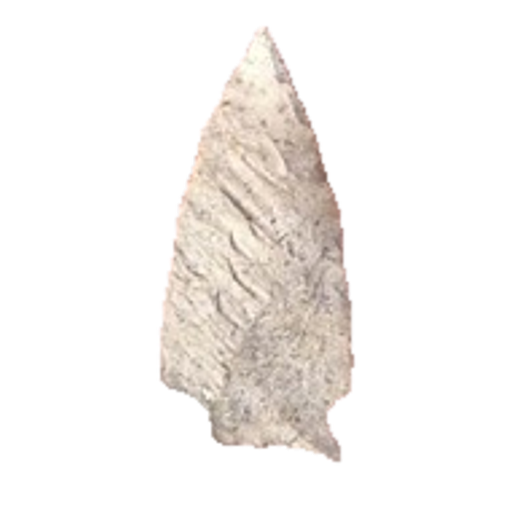
Arrowhead type
Gull Lake Point
Gull LakePlains Small Side Notch Cluster1,800 - 900 B.P.Late Woodland3 reference photos
Key facts
- Age
- 1,800 - 900 B.P.
- Cultural period
- Late Woodland
- Culture
- Avonlea Culture
- Size
- Small to Medium
- Shape
- Side Notch to Bifurcated
- Glacial period
- Roman to Medieval Warm
More from the Woodland period
Description
This side-notched point exhibits a slender profile, with a cross-sectional shape that transitions from elliptical to flattened. The blade's curvature can vary, ranging from straight to gently curved outward. Characteristic of this point are its low and shallow parallel notches, which form shoulders that may be oriented horizontally or slope upward slightly. The stem can either expand outward or be fully expanded. A concave base is typical, often accompanied by subtle grinding in the basal and hafting areas. Notably, this variation tends to be more elongated and narrower than its counterparts. The point's surface displays a high degree of refinement, achieved through precise pressure flaking that yields a flaking pattern ranging from parallel oblique to random.
Size
The arrowheads exhibit a range of dimensions, with overall lengths spanning 12 to 38 mm, blade widths varying from 9 to 18 mm, and thicknesses measuring between 2 to 4 mm.
Distribution
This type is mainly discovered in Saskatchewan and Alberta, Canada, and extends into Montana (red). It also appears with decreased regularity in northern Wyoming, northern South Dakota, northwestern Iowa, and western Minnesota (yellow)
Mainly found in
Additional information
The Avonlea point type is considered a pivotal development in the evolution of Native American arrowheads, with its origins tracing back to the Pelican Lake type. Notably, Avonlea points represent the earliest manifestation of the Prairie Side Notch type, marking the beginning of a distinct technological and stylistic trajectory. According to the seminal work of Kehoe (1966), the Avonlea type underwent a subsequent transformation, giving rise to the Swift Current type, which ultimately coalesced into the characteristic Prairie Side Notch form. This sequence of development underscores the dynamic nature of prehistoric technological innovation, highlighting the complex and nuanced processes that shaped the material culture of Native American communities.
A key aspect of the Avonlea point type is its position as a precursor to later Prairie Side Notch variants, demonstrating a clear continuity of design and functional principles. The work of Kehoe (1966) provides invaluable insights into the morphological characteristics and chronological placement of Avonlea points, offering a foundational understanding of this significant archaeological type. By examining the Avonlea point type within the context of its evolutionary sequence, researchers can gain a deeper appreciation for the technological and cultural exchanges that occurred among prehistoric populations, as well as the adaptive strategies that influenced the development of lithic tool traditions.
The Avonlea point type's significance extends beyond its role as a precursor to later Prairie Side Notch forms, as it also offers a window into the lives and cultural practices of the people who created and utilized these artifacts. Through the study of Avonlea points and their evolutionary trajectory, archaeologists can reconstruct aspects of prehistoric technological organization, subsistence strategies, and social interaction, ultimately contributing to a more nuanced understanding of Native American cultural diversity and historical complexity. By exploring the Avonlea point type within its broader archaeological context, researchers can continue to refine our knowledge of this fascinating period in Native American history.
Identified by
- Named by
- Thomas Kehoe
- Year
- 1961
- Type site
- Avonlea Site, south central Saskatchewan, Canada / Gull Lake Bison Kill Site Saskatchewan, Canada
Similar types
Types that are easy to confuse with the Gull Lake point.
- Besant
- Elko Eared
- Irvine
- Lewis
- Lookingbill
- Nanton
- Pekisko
- Paskapoo
- Samantha
- Swift Current
- Tompkins
- Washita
Other types in the Plains Small Side Notch Cluster
- Avonlea Carmichael
- Avonlea Timber Ridge
- Plains Side Notch
- Prairie Side Notch