
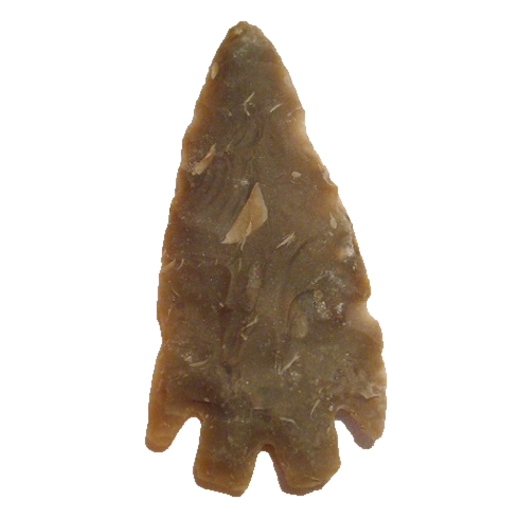
Arrowhead type
Montell Point
Montell3,000 - 1,000 B.P.Late Archaic to Transitional Archaic34 reference photos
Key facts
- Age
- 3,000 - 1,000 B.P.
- Cultural period
- Late Archaic to Transitional Archaic
- Size
- Medium to Large
- Shape
- Expanding Stem to Bifurcated to Corner Notch
- Material
- Limestone
- Glacial period
- Neoglacial to Modern Times
More from the Archaic period
Description
This bifurcated point exhibits a medium to large size profile, characterized by a cross-sectional morphology that is notably flattened. The blade's curvature is predominantly excurvate, although its shape can vary from straight to recurvate in instances where the point has undergone re-sharpening. The blade may also feature serrations, accompanied by unifacial beveling, which adds to its functional complexity. The shoulders of the point are typically barbed, but can also occur in a horizontal orientation. The stem's configuration can range from straight to expanding, demonstrating variability in its form. A distinctive center notch is present at the base, which is elongated and narrow, giving rise to basal ears with a squarish silhouette. The flaking pattern observed on this point is random, yet it often displays a high level of craftsmanship, underscoring the skill of its manufacturer.
Size
The dimensions of the arrowheads are characterized by the following measurements: overall length ranges from 40 to 100 mm, with a mean length of 60 to 70 mm. The stem, which accounts for approximately 1/10 to 1/4 of the total length, measures between 10 and 20 mm. The maximum width, observed at the shoulders, spans 30 to 50 mm. The neck width is recorded as 18 to 28 mm, while the stem width falls within the range of 20 to 30 mm, as documented by Suhm and Krieger (1952).
Distribution
This type is mainly discovered throughout the Edwards Plateau and extending into the Big Bend area and the central Rio Grande River valley of Texas and northern Coahuila
Additional information
In the realm of Native American archaeology, a particular point style has undergone a notable evolution in nomenclature. Initially, F. Bryan coined the term "Delia Notch Base" in 1936 to describe specimens unearthed in Delia, Limestone County, Texas. However, this designation was short-lived, as J. C. Kelley reintroduced the point in 1947 under the name "Montell Split Stem." The most significant contribution to our understanding of this point style came in 1954, when Ann Dee Suhm, Alex D. Krieger, and Edwards B. Jelks provided a more detailed description, ultimately simplifying the name to "Montell." This refinement in terminology has since been widely adopted, reflecting a deeper understanding of the point's characteristics and cultural significance.
The Montell point's history of renaming underscores the dynamic nature of archaeological classification, where ongoing research and discovery often lead to revisions in our understanding of ancient cultures. The fact that this point style was first identified in Delia, Texas, highlights the importance of regional excavations in shaping our knowledge of Native American material culture. Furthermore, the contributions of prominent archaeologists such as Bryan, Kelley, Suhm, Krieger, and Jelks demonstrate the collaborative effort that has driven the field forward, enabling a more nuanced appreciation of the Montell point's place within the broader context of Native American archaeology.
The Montell point's nomenclatural journey serves as a testament to the evolving nature of archaeological inquiry, where initial observations are refined and expanded upon through continued research and scholarly discourse. As our understanding of this point style continues to grow, so too does our appreciation for the cultural and historical contexts in which it was created, providing valuable insights into the lives and traditions of Native American communities in Texas and beyond.
Identified by
- Named by
- J. Charles Kelley and Suhm and Krieger
- Year
- 1947
Similar types
Types that are easy to confuse with the Montell point.