
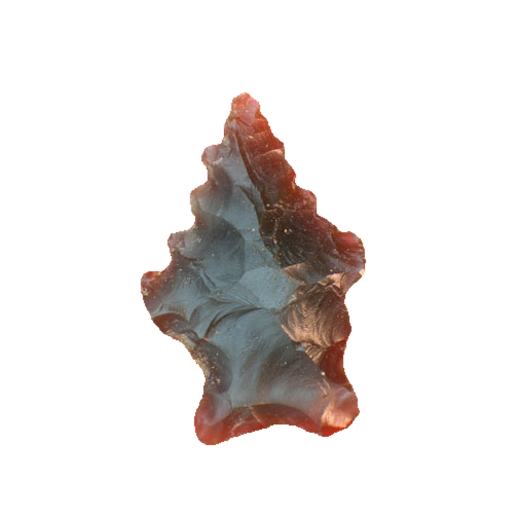
Arrowhead type
Frederick Bifurcated Point
Frederick BifurcatedLeCroy Cluster9,000 - 7,000 B.P.Early Archaic3 reference photos
Key facts
- Age
- 9,000 - 7,000 B.P.
- Cultural period
- Early Archaic
- Size
- Small to Medium
- Shape
- Bifurcated to Expanding Stem
- Glacial period
- Early Holocene
More from the Archaic period
Description
This triangular point exhibits a distinctive bifurcated form, characterized by an elliptical apex. The blade profile is predominantly incurvate, with a notable flare at the shoulder edge, although some specimens display a straight blade configuration. The shoulders themselves exhibit a range of orientations, from horizontal to barbed, often sweeping upwards towards the distal terminus. The stem expands towards the base, which is bifurcated in form. The flaking pattern observed on this point is random, lacking a discernible order or arrangement. The overall morphology is marked by a medium size and triangular shape, with the aforementioned characteristics combining to form a unique and identifiable point type.
Size
The dimensions of the arrowheads are as follows: they range in overall length from 24 to 50 mm, with stem lengths varying between 9 and 13 mm. The width of the blade at the shoulders measures between 19 and 32 mm, while the neck width falls within the range of 9 to 14 mm. Additionally, the stem width is between 11 and 16 mm, and the thickness of the arrowheads ranges from 3 to 7 mm.
Distribution
These artifacts are mainly linked to the Tennessee River basin region.
Mainly found in
Also found, less often, in
Additional information
In the realm of Native American arrowhead typology, a distinct southern variant has been identified, which bears a notable resemblance to the Fox Valley type. One of the defining characteristics of this particular variation is the presence of exaggerated or bulbous shoulders, a feature that sets it apart from its counterparts. This unique morphological trait is a key identifying factor for archaeologists seeking to classify and understand the cultural context of these artifacts.
The southern variant's affinity with the Fox Valley type is evident, yet its distinctive shoulder morphology underscores the regional diversity and adaptability of Native American projectile point technology. The bulbous shoulders of this variant likely served a functional purpose, potentially enhancing the arrowhead's aerodynamics or facilitating a more secure hafting arrangement. Further research is needed to fully elucidate the significance of this design element, but its presence undoubtedly contributes to a more nuanced understanding of the technological and cultural developments of the region's indigenous populations.
Through the study of this southern variant, archaeologists can gain valuable insights into the complex and dynamic nature of Native American material culture, highlighting the importance of regional variation and innovation in the development of projectile point technology. By examining the characteristics of this variant, including its exaggerated shoulders, researchers can reconstruct a more detailed picture of the cultural and technological exchange networks that existed among Native American groups, ultimately enriching our understanding of the rich and diverse cultural heritage of these communities.
Identified by
- Named by
- Curtis H. Tomak
- Year
- 1980
- Type site
- White River Valley, Indiana
Similar types
Types that are easy to confuse with the Frederick Bifurcated point.