
Arrowhead type
Fountain Creek Point
Fountain Creek9,000 - 7,000 B.P.Early Archaic5 reference photos
Key facts
- Age
- 9,000 - 7,000 B.P.
- Cultural period
- Early Archaic
- Size
- Medium
- Shape
- Side Notch to Corner Notch
- Glacial period
- Early to Middle Holocene
More from the Archaic period
Description
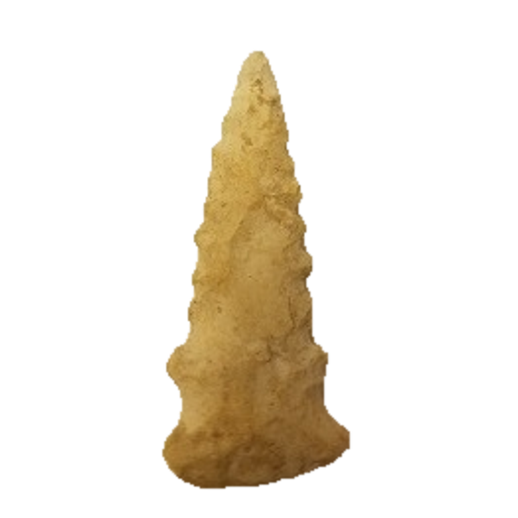
This medium-sized, triangular point exhibits a distinctive elliptical profile, characterized by a straight, deeply serrated blade bearing between three to six pronounced notches. The horizontal shoulders transition into a stem that expands outward, sometimes presenting a bulbous appearance, particularly in specimens with a convex base. The basal morphology varies, ranging from slightly convex to convex, with rounded corners that soften the overall outline. A notable feature of this point type is the presence of basal grinding, which suggests a deliberate effort to shape and refine the base. The flaking pattern on this point is random, lacking a discernible order or sequence, and is often accompanied by a mix of flake scars that attest to the toolmaker's technique.
Size
The dimensions of the arrowheads are characterized by the following measurements: overall length ranges from 32 to 60 mm, with a mean length of 40 mm. The stem measures between 8 and 13 mm in length. The blade width spans 20 to 30 mm, while the stem width varies from 13 to 23 mm. Additionally, the neck width is between 10 and 20 mm, averaging 15 mm.
Distribution
This type is predominantly linked to the Virginia Piedmont and extends into North Carolina. It can also be located within the Blue Ridge area of Virginia, North Carolina, and Tennessee, albeit with lesser occurrence.
Additional information
More information needed.
Identified by
- Named by
- Floyd Painter
- Year
- 1978
Similar types
Types that are easy to confuse with the Fountain Creek point.