
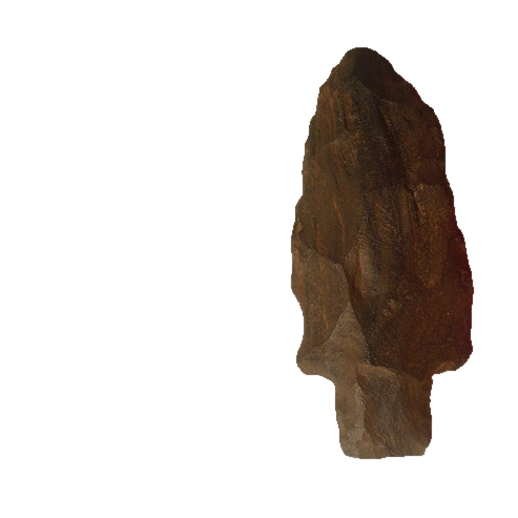
Arrowhead type
Pontchartrain Type II Point
Pontchartrain Type IITerminal Archaic Barbed Cluster3,500 - 2,000 B.P.Late Archaic to Early Woodland10 reference photos
Key facts
- Age
- 3,500 - 2,000 B.P.
- Cultural period
- Late Archaic to Early Woodland
- Size
- Medium to Large
- Shape
- Straight Stem to Contracting Stem
- Material
- Flint
- Glacial period
- Neoglacial to Roman Warm
Description
This stemmed point exhibits a distinctive morphology, characterized by a medium to large size and a narrow, elongated blade. The cross-sectional profile is marked by a median ridge, often assuming a diamond-shaped configuration, which may be present on one or both faces, with the opposing face being flat. The blade's proportions are notable, typically measuring three times as long as its width, and often displaying an excurvate shape, although some specimens may exhibit a pentagonal appearance, with excurvate curvature near the tip and parallel sides. The shoulders are adorned with short, small barbs, while the stem is generally straight, albeit with occasional slight expansion. The base of the point can vary, ranging from straight to mildly convex. The flaking pattern is characterized by the presence of well-executed ripple flakes, which often extend from the edge to the face, although some examples feature pressure flaking used to retouch the edges, resulting in a more random and irregular flaking pattern.
Size
The arrowheads exhibit a range of dimensions, with total lengths spanning 48 to 110 mm, typically averaging between 60 to 80 mm. The stem portion measures 10 to 20 mm in length, while the blade width ranges from 25 to 40 mm, with an average width of 33 to 38 mm. Additionally, the stem width varies from 15 to 22 mm.
Distribution
This type is mainly discovered in the southern Mississippi River basin and extending into the Red River basin.
Additional information
In the realm of Native American arrowheads, the Pontchartrain type series presents an intriguing case study. Notably, the Pontchartrain Type II point exhibits a more limited geographic distribution compared to its Type I counterpart. A key distinguishing feature between the two types lies in their blade morphology: the Pontchartrain Type I typically boasts a longer and narrower blade, whereas the Type II point has a more compact blade. Furthermore, the shoulders of the Type I point are characterized by a horizontal to upward-sloping orientation, setting it apart from the Type II.
Another significant difference between the two types can be observed in their basal morphology. The base of the Pontchartrain Type I point is often wider and squarer, frequently retaining the cortex rind on the basal edge. This characteristic is less common in the Type II point. Additionally, the blade of the Type I point may display a noticeable twist, a feature that is not typically seen in the Type II point. This twist, combined with the other distinctive characteristics, underscores the unique attributes of the Pontchartrain Type I point.
The classification of these points has been formalized by Perino (1968), who designated the Type I as the "Pontchartrain Typical" and the Type II as the "Pontchartrain Corner Notch". This typological distinction highlights the importance of careful analysis and classification in understanding the nuances of Native American arrowhead technology. By examining the subtle differences between the Pontchartrain Type I and Type II points, researchers can gain valuable insights into the cultural and technological contexts in which these artifacts were created and used.
Identified by
- Named by
- James A. Ford and Clarence H. Webb
- Year
- 1956
- Type site
- Poverty Point, West Carol Parish. Louisiana
Similar types
Types that are easy to confuse with the Pontchartrain Type II point.
- Buck Creek
- Flint Creek
- Hardin
- Hamilton Stemmed
- Lange
- Little Bear Creek
- Morris
- Morhiss
- Mulberry Creek