
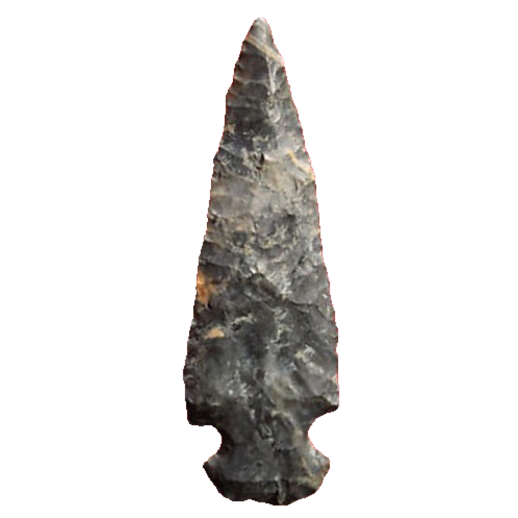
Arrowhead type
Beacon Island Point
Beacon Island3,500 - 2,200 B.P.Late Archaic to Early Woodland20 reference photos
Key facts
- Age
- 3,500 - 2,200 B.P.
- Cultural period
- Late Archaic to Early Woodland
- Size
- Medium
- Shape
- Expanding Stem
- Material
- Flint
- Glacial period
- Neoglacial to Roman Warm
Description
This triangular point, measuring between 1.75 and 3 inches in length, exhibits an elliptical cross-sectional profile. Its blade edge can vary from straight to excurvate, often featuring fine serrations. The shoulders are characterized by a subtle upward inclination, sometimes giving way to a slightly barbed morphology. The stem, which expands outward, is marked by a convex base, imparting a distinctive bulbous shape. The flaking pattern on this point is randomized, resulting from a combination of shallow percussion flaking on the blade's surface and pressure flaking, which serves to refine the blade's shape and thin out the base.
Size
The arrowheads exhibit the following dimensional characteristics: overall length ranges from 48 to 73 mm, with a mean length of 61 mm. The stem segment measures between 12 and 18 mm in length, averaging 15 mm. The blade width varies from 22 to 28 mm, with an average width of 24 mm. The neck width spans 11 to 22 mm, while the stem width ranges from 15 to 19 mm, averaging 17 mm. In terms of thickness, the arrowheads measure between 6 and 7 mm.
Distribution
This type is mainly discovered in the Tennessee River Valley and extending into the Ohio River Valley. This type has also been identified in southern Illinois and eastern Missouri, albeit with lesser occurrence.
Also found, less often, in
Additional information
More information needed.
Identified by
- Named by
- Ralph Allen and James Hulse
- Type site
- Ralph Allen Site 41, Beacon Island, Alabama
Similar types
Types that are easy to confuse with the Beacon Island point.