
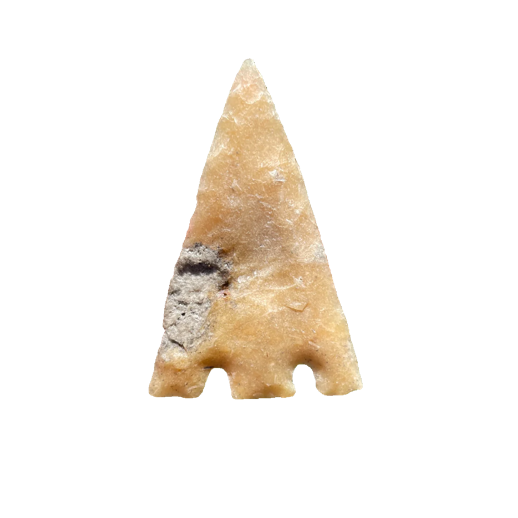
Arrowhead type
Hernando Point
Hernando2,400 - 1,600 B.P.Early Woodland to Middle Woodland23 reference photos
Key facts
- Age
- 2,400 - 1,600 B.P.
- Cultural period
- Early Woodland to Middle Woodland
- Size
- Small to Medium
- Shape
- Basal Notch
- Glacial period
- Roman Warm
More from the Woodland period
Description
This triangular point exhibits a basal notch morphology, characterized by a slender profile, measuring between 1.5 to 2.5 inches in length. Its cross-sectional shape ranges from flattened to elliptical. The blade edge is predominantly straight, although it may occasionally exhibit a subtle excurvate curvature. Serrations are present on fewer than 15% of specimens, adding a rare instance of texture to the otherwise smooth edge. The barbed shoulders extend downward, merging with the base of the point, which features short, U- or V-shaped notches. The stem's orientation varies, ranging from straight to contracting, while the base of the point can be either straight or tapered to a point. The flaking pattern observed on this point is random, and overall, the craftsmanship is of high quality, indicative of skilled manufacture.
Size
The dimensions of these arrowheads are characterized by the following measurements: overall length ranges from 26 to 63 mm, with a mean length of 35 to 48 mm. The stem, a distinct component, measures between 3 to 7 mm in length, averaging 4 to 5 mm. In terms of breadth, the arrowheads span 18 to 40 mm, with an average width of 25 to 35 mm. The stem's width varies from 3 to 13 mm, with two distinct types: type 1 typically measuring 3 to 7 mm and type 2 measuring 7 to 13 mm. The thickness of these artifacts falls within the range of 5 to 9 mm.
Distribution
This type is mainly discovered in Florida, extending into southern Georgia and southern Alabama. It has infrequently been spotted in central Georgia and the southwestern region of South Carolina
Mainly found in
Also found, less often, in
Additional information
In the realm of Native American arrowhead typology, the distinction between Citrus and Hernando points has been a subject of ongoing debate. While some researchers propose that these two types represent opposite ends of a continuum, others argue that they are distinct categories. Notably, both types are often found in the same geographic regions and exhibit similar characteristics, frequently co-occurring at the same archaeological sites and stratigraphic levels. This overlap has led some to suggest that the Citrus and Hernando points may be variants of a single type. A key difference between the two lies in their stem morphology, with Citrus points typically featuring a wider stem with deeper notches, as observed by Granger and Granger (2013).
A closer examination of the two types reveals additional distinguishing features. The Citrus point is characterized by a convex basal edge, which forms a circular pattern from the tip of one barb to the tip of the other, and an excurvate blade with rounded edges on the outer barbs, as described in specimen W18. In contrast, Hernando points have a straighter blade with squarer barbs and a straight basal edge. Furthermore, Citrus points tend to be slightly larger than their Hernando counterparts. This size difference has led some researchers, including Bullen (1975), to propose that the Citrus point may be a knife form of the Hernando point. According to Bullen (1975), the primary distinguishing feature between the two types is the "basally curved tang" or "rocker" base, which is a distinctive characteristic of the Citrus point.
The similarities and differences between Citrus and Hernando points highlight the complexities of Native American arrowhead typology. While the debate surrounding the relationship between these two types continues, a thorough understanding of their characteristics and distribution is essential for advancing our knowledge of prehistoric cultures in the region. By examining the morphological features and contextual information associated with these points, researchers can gain valuable insights into the technological, social, and cultural practices of the peoples who created them. Ultimately, a nuanced understanding of the Citrus and Hernando points can contribute to a more comprehensive picture of the lives and traditions of Native American communities in the past.
Identified by
- Named by
- Ripley P. Bullen
- Year
- 1968
Similar types
Types that are easy to confuse with the Hernando point.
- Citrus
- Culbreath
- Hillsborough