
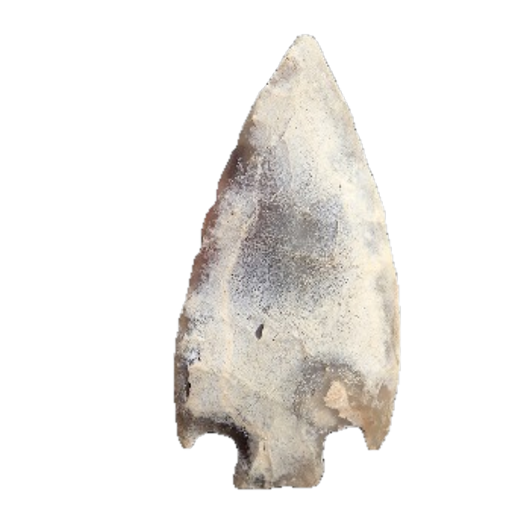
Arrowhead type
Culbreath Point
Culbreath4,000 - 3,000 B.P.Late Archaic14 reference photos
Key facts
- Age
- 4,000 - 3,000 B.P.
- Cultural period
- Late Archaic
- Size
- Medium
- Shape
- Basal Notch to Straight Stem
- Glacial period
- Neoglacial
More from the Archaic period
Description
This basal notch point exhibits a size range of 1.5 to 3 inches, characterized by a slender, elliptical profile. The blade itself is notably broad, with an excurvate shape that curves inward and then back toward the base, forming a distinctive tip. The maximum blade width is situated in the lower third, lending a sense of balance to the overall form. The shoulders of the point are barbed, with rounded edges that can extend anywhere from halfway down the stem to the base. The stem's shape varies, ranging from straight to slightly contracting, never expanding, and is paired with a base that can be either straight or convex. The flaking pattern observed on this point is random, lacking a discernible order or sequence.
Size
The dimensions of the arrowheads are characterized by the following measurements: overall length ranges from 55 to 110 mm, with a typical average span of 65 to 75 mm. The stem, a distinct component, measures between 8 to 12 mm in length. In terms of width, the arrowheads exhibit a range of 35 to 55 mm, with an average width of 38 to 42 mm. Furthermore, the stem width is observed to be between 15 to 20 mm.
Distribution
This type is mainly located in middle Florida, particularly the Tampa Bay region. They can also be discovered in southwest Alabama and southern Georgia, albeit less commonly.
Additional information
In a seminal study published in 1975, Bullen identified two distinct variants within the Culbreath type of Native American arrowheads. The first variant, designated as Subtype I, is characterized by its classic Culbreath morphology, featuring barbs that typically extend to the base of the point, accompanied by a broad stem with a flat base. In contrast, Subtype II exhibits slightly shorter barbs, a longer stem, and a base that contracts with a convex to straight profile. Notably, the stem morphology of Subtype II differs significantly from that of Subtype I, highlighting the diversity within the Culbreath type.
Further insights into the characteristics of Culbreath points can be gleaned from the analysis of specimens recovered from the Blackwater Pond Site, as observed by Schoder. A significant finding is that as these points undergo re-sharpening, they exhibit distinct distal changes, resulting in a shorter, yet broader point. This transformation can be so pronounced that the re-sharpened point may resemble a circular, hafted scraper, rather than a traditional arrowhead. This observation underscores the dynamic nature of tool use and maintenance among Native American communities, where artifacts were often re-purposed or re-shaped to extend their functional lifespan.
The study of Culbreath points, including their variants and transformations, offers a fascinating window into the technological and cultural practices of Native American groups. By examining the morphological characteristics of these artifacts, researchers can gain a deeper understanding of the complex relationships between tool design, use, and reuse, as well as the cultural contexts in which they were employed. As such, the analysis of Culbreath points contributes significantly to our knowledge of Native American archaeology, highlighting the importance of considering the functional, social, and cultural dimensions of artifact use and production.
Identified by
- Named by
- Ripley P. Bullen
- Year
- 1968
- Type site
- Culbreath Bayou Site, Tampa City, Florida
Similar types
Types that are easy to confuse with the Culbreath point.