
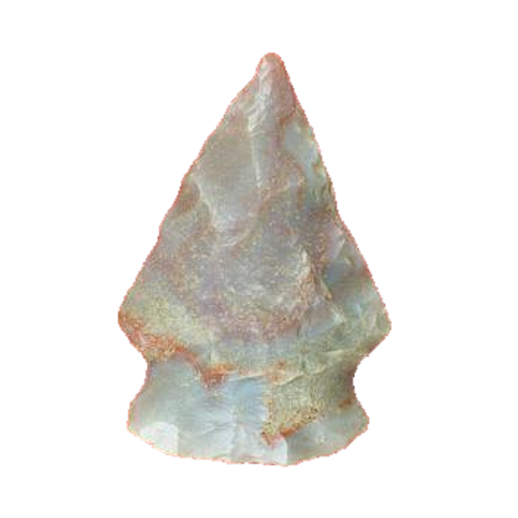
Arrowhead type
Ecusta Notched Point
Ecusta Notched7,000 - 5,000 B.P.Middle Archaic2 reference photos
Key facts
- Age
- 7,000 - 5,000 B.P.
- Cultural period
- Middle Archaic
- Size
- Small to Medium
- Shape
- Expanding Stem to Side Notch
- Glacial period
- Middle Holocene
More from the Archaic period
Description
This triangular side notch point exhibits a distinctive rhomboid profile, with a length that falls within the small to medium range. Its straight-edged blade features a beveled edge, accompanied by serrations that impart a toothed appearance. The presence of parallel, shallow notches creates subtle, sloping shoulders that can be oriented either horizontally or at a slight upward incline. The stem, which expands in width, terminates in a convex base, providing a sturdy foundation. The flaking pattern observed on this point is characterized by a non-directional, random arrangement of flake scars.
Size
The arrowhead's dimensions are characterized by a total length spanning 25 to 35 mm. The stem, which averages 10 mm in length, ranges from 9 to 15 mm. The blade's width varies between 18 and 30 mm, while the stem's width is comparable, being slightly wider or narrower than the blade. Additionally, the neck width measures between 15 and 23 mm.
Distribution
This point is mainly located in the sources of the Tennessee River and throughout the entire Tennessee River basin.
Also found, less often, in
Additional information
In the realm of Native American archaeology, a particular type of arrowhead has garnered significant attention due to its distinctive characteristics. Notably, these artifacts have been identified as Palmer points, which were likely re-sharpened, as proposed by Coe in 1964. This observation highlights the resourcefulness and ingenuity of the indigenous cultures that created these tools, as they sought to extend the lifespan of their arrowheads through meticulous re-sharpening techniques.
Further examination of these points can be found in the Central States Archaeological Journal, where they are referred to as Escusta points (CSAJ, Volume 2, Page 15). This nomenclature provides a framework for understanding the cultural and geographical context in which these arrowheads were crafted and utilized. By exploring the characteristics and distribution of Escusta points, researchers can gain valuable insights into the lives and traditions of the Native American communities that created them, shedding light on the complexities of their technological, social, and economic practices.
The study of these re-sharpened Palmer points, or Escusta points, offers a unique window into the lives of Native American cultures, allowing archaeologists to reconstruct the ways in which these communities interacted with their environments and adapted to the challenges they faced. Through a nuanced analysis of these artifacts, researchers can uncover the intricacies of indigenous technological traditions, ultimately deepening our understanding of the rich cultural heritage of Native American societies.
Identified by
- Named by
- C. R. Harwood
- Year
- 1958
- Type site
- Osbourne Site, Transylvania County, North Carolina
Similar types
Types that are easy to confuse with the Ecusta Notched point.