
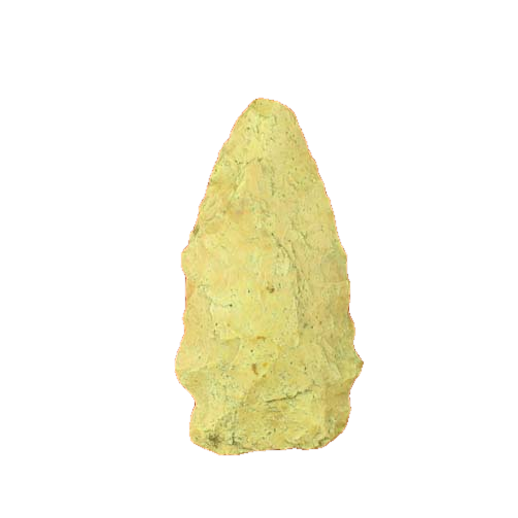
Arrowhead type
Coosa Side Notch Point
Coosa Side Notch2,000 - 1,500 B.P.WoodlandKey facts
- Age
- 2,000 - 1,500 B.P.
- Cultural period
- Woodland
- Size
- Medium
- Shape
- Side Notch
- Material
- Pottery
- Glacial period
- Roman
More from the Woodland period
Description
This triangular side notch point exhibits a stout profile, typically measuring between 1.25 to 2 inches in thickness. Cross-sectional shapes vary, with elliptical forms being predominant, although some specimens display unifacial or flattened profiles. The blade morphology is often asymmetrical, characterized by an excurvate curvature, while straight-edged examples also occur. Serrations or beveling may be present on the blade, adding a layer of refinement to its edge. The shoulders of the point are typically angled upward, but can also be found in a horizontal orientation or, less frequently, with a slightly barbed configuration. Notches are generally shallow, resulting in an expanding or expanded stem. The basal contour ranges from mildly convex to mildly concave. Flaking patterns on these points are predominantly random, and their overall craftsmanship is often coarse, suggesting a more expedient manufacturing approach.
Size
The dimensions of the arrowheads are as follows: - The overall length ranges from 22 to 52 mm, with an average length of 33 to 39 mm. - The stem measures between 6 and 12 mm in length, averaging 7 to 9 mm. - The blade width varies from 15 to 28 mm, with an average width of 19 to 22 mm. - The neck width is between 11 and 15 mm. - The stem width ranges from 12 to 18 mm, averaging 13 to 15 mm. - The thickness of the arrowhead is between 7 and 8 mm.
Distribution
This type is mainly located in the Coosa River area, yet can also be discovered in the Tennessee River Valley spanning southern Tennessee, northern Alabama, and extending into northeastern Mississippi and northwestern Georgia
Also found, less often, in
Additional information
In a notable observation, researcher Whatley (2002) cites a personal communication with George Price, which sheds light on the temporal and cultural context of Coosa Notched and Coosa Stemmed arrowheads. Specifically, Price's findings suggest that these point styles are often discovered in conjunction with Late Cartersville and Swift Creek ceramics in the northwestern region of Georgia. This association is significant, as it implies that Coosa Notched points were still in use during the Middle Woodland period, a timeframe that spans several centuries. Based on this evidence, archaeologists estimate that the Coosa Notched points have a broad chronological range of approximately 2500 to 1500 years before present (BP), providing valuable insights into the technological and cultural developments of the region's indigenous populations during this period.
The co-occurrence of Coosa Notched and Coosa Stemmed points with specific pottery styles is a crucial aspect of this research, as it allows archaeologists to reconstruct the cultural and temporal dynamics of the region. The presence of Late Cartersville and Swift Creek pottery, in particular, serves as a diagnostic marker for the Middle Woodland period, enabling researchers to situate the Coosa Notched points within a broader cultural and chronological framework. By examining the distribution and association of these artifacts, researchers can gain a more nuanced understanding of the social, economic, and technological developments that characterized the lives of Native American communities in northwestern Georgia during this time.
The estimated date range of 2500-1500 BP for Coosa Notched points underscores the complexity and diversity of the region's cultural landscape during the Middle Woodland period. This prolonged timeframe suggests that the Coosa Notched point style underwent significant transformations and adaptations, potentially reflecting changes in the social, environmental, or economic contexts of the communities that produced and used them. As such, further research into the Coosa Notched points and their associated cultural contexts is essential for deepening our understanding of the rich and dynamic history of Native American cultures in the region.
Identified by
- Named by
- David DeJannette
- Year
- 1973
- Type site
- Coker Ford Site, Coosa River, Cherokee County, Alabama
Similar types
Types that are easy to confuse with the Coosa Side Notch point.
- Brewerton
- Buggs Island
- Crawford Creek
- Ecusta
Other types in this cluster
- Coosa Stemmed
- Triangular Copena
- Greenville
- Nolichucky