
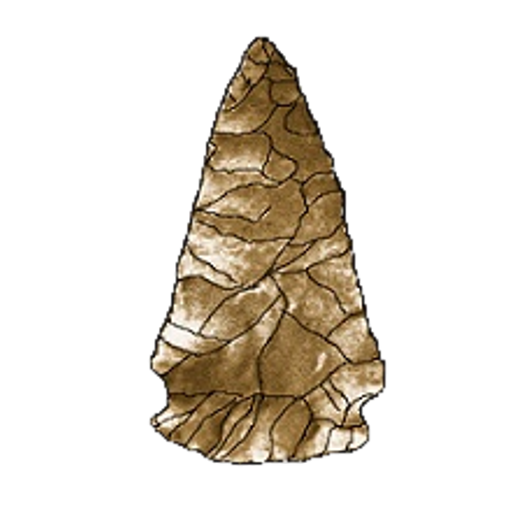
Arrowhead type
Damron Point
Damron5,000 - 4,000 B.P.Early Archaic3 reference photos
Key facts
- Age
- 5,000 - 4,000 B.P.
- Cultural period
- Early Archaic
- Size
- Small to Medium
- Shape
- Side Notch
- Material
- Shell
- Glacial period
- Middle Holocene to Neoglacial
More from the Archaic period
Description
This triangular side notch point exhibits a compact to moderate size profile. In cross-section, its shape can vary from an oval silhouette to a more compressed form. The blades display a range of curvature, from straight to excurvate, with some specimens showcasing a straight edge on one side and an excurvate edge on the other. Fine serrations are a common feature along the blade edges. The notches are characterized by shallow, parallel flaking, accompanied by shoulders that slope upward at a gentle to moderate angle. The stem broadens outward, while the base is typically convex, although it can occasionally appear straight. The base is rarely polished through grinding but often features a beveled edge. The overall flaking pattern appears to be random, lacking a discernible order or orientation.
Size
The arrowheads exhibit the following dimensional characteristics: - Overall length ranges from 37 mm to 72 mm, with a mean length of 49 mm. - The stem measures between 7 mm and 11 mm in length, averaging 9 mm. - Blade width varies from 24 mm to 32 mm, with an average width of 27 mm. - The neck width, defined by the notch, is between 7 mm and 8 mm. - Stem width ranges from 19 mm to 29 mm, with an average of 24 mm. - Thickness measurements fall within the range of 7 mm to 10 mm.
Distribution
This type is located throughout the Tennessee River Valley, spanning central to south-central Tennessee and extending into northern Alabama
Also found, less often, in
Additional information
In the Wheeler Valley of the Tennessee River Valley, surface collections at pre-shell mound sites have yielded arrowheads that initially suggested an Early Archaic affiliation. However, further investigation at the Flint Creek Rock Shelter and the Stanfield-Worley Bluff Shelter revealed the presence of these points in Middle Archaic strata, prompting a reevaluation of their chronological placement. As noted by Cambron in 1975, this revised context securely situates these arrowheads within the Middle Archaic period.
The classification of these points has undergone refinement over time. Initially, they were categorized as Upper Valley Side Notch based on examples recovered from the Damron Site and the Quad Site, as documented by Cambron in 1975. This initial classification was likely due to similarities in morphology and technological characteristics. Nevertheless, the subsequent discovery of these points in Middle Archaic contexts has provided a more nuanced understanding of their cultural and temporal significance.
The reassignment of these arrowheads to the Middle Archaic period highlights the importance of stratigraphic context in archaeological interpretation. By considering the layered deposits at sites like the Flint Creek Rock Shelter and the Stanfield-Worley Bluff Shelter, researchers can reconstruct a more accurate timeline of cultural development and technological innovation in the region. The study of these arrowheads, in conjunction with other artifact classes, contributes to a deeper understanding of the lives and traditions of Native American communities in the Tennessee River Valley during the Middle Archaic period.
Identified by
- Named by
- James Cambron and David Hulse
- Year
- 1975
- Type site
- Damron Site, Lincoln County, Tennessee
Similar types
Types that are easy to confuse with the Damron point.