
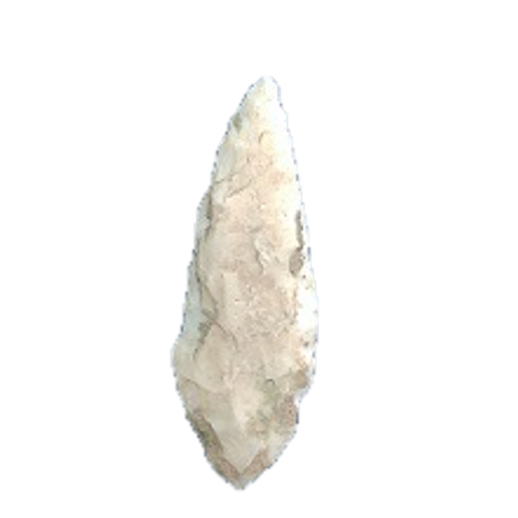
Arrowhead type
Desmuke Diamond Point
Desmuke Diamond3,000 - 2,000 B.P.Middle Woodland8 reference photos
Key facts
- Age
- 3,000 - 2,000 B.P.
- Cultural period
- Middle Woodland
- Size
- Small to Medium
- Shape
- Contracting Stem to Ovoid
- Material
- Quartzite
- Glacial period
- Neoglacial to Roman Warm
More from the Woodland period
Description
This artifact is characterized by a compact, lozenge-shaped morphology, exhibiting a thick profile that tapers towards the base. In cross-section, the point displays a robust, elliptical to diamond-shaped form, often featuring a pronounced medial ridge that traverses both surfaces. The blade itself is generally straight or subtly curved outward, with its maximum width typically occurring at the shoulder or approximately one-third of the distance from the base. Notably, many specimens exhibit beveled edges on each face, and some display serrations. The absence of discernible shoulders is a distinctive feature of this point type. The stem, which contracts towards the base, presents a convex to pointed termination, with one basal edge often being relatively straight and the other more curved. The flaking pattern is dominated by coarse percussion flaking, supplemented by targeted pressure flaking along the edges, resulting in a distinctive texture and morphology.
Size
The dimensions of the arrowheads range from 30 to 50 millimeters in length and 15 to 25 millimeters in width, as per the standards outlined by Suhm and Krieger (1954).
Distribution
This type is mainly discovered in the Frio and Nueces River basins and the southern Rio Grande River Valley of Texas and Mexico. Its presence becomes less common as it extends into the coastal areas and central Texas. Sightings have also been documented as far as the Valley of Mexico
Additional information
More information needed.
Identified by
- Named by
- Dee Ann Suhm
- Year
- 1954
Similar types
Types that are easy to confuse with the Desmuke Diamond point.