
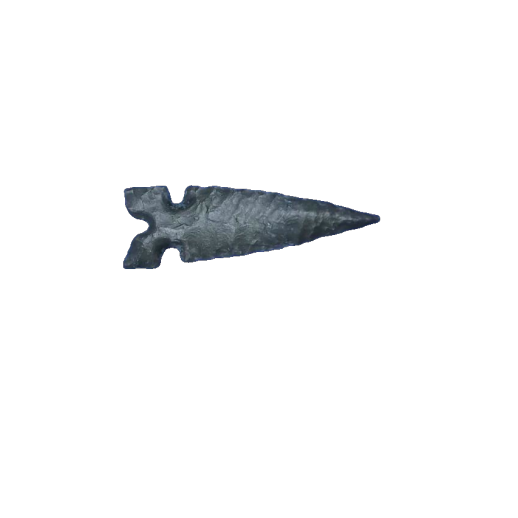
Arrowhead type
Desert Sierra Point
Desert SierraDesert Side Notch Cluster800 - 200 B.P.Late Prehistoric to Historic12 reference photos
Key facts
- Age
- 800 - 200 B.P.
- Cultural period
- Late Prehistoric to Historic
- Culture
- Apache, Hopi. Gosiut, Moki, Northern Paiute, Shoshone, Uroc, and many other cultures
- Size
- Small
- Shape
- Side Notch to Bifurcated
- Material
- Obsidian
- Glacial period
- Medieval Warm to Little Ice Age
More from the Late Prehistoric, Historic periods
Description
This triangular point exhibits a slender profile, characterized by a flattened cross-sectional morphology. Its straight-edged blade may occasionally display a subtle curvature, while numerous specimens feature delicate serrations along their edges. The parallel notches, positioned below the midpoint, are typically narrow and deep, often resulting in a constricted neck. The horizontal shoulders are accompanied by an expanded stem, and the basal edges often exhibit a squared morphology. The base itself is generally straight or slightly concave, frequently incorporating a central basal notch. The manufacturing process involves the removal of percussion flakes, followed by shaping and finishing via pressure flaking, yielding a random, non-patterned flaking arrangement.
Size
The arrowheads exhibit a range of dimensions, with overall lengths spanning 9 to 40 mm, and averaging between 17 and 26 mm. The stem section measures between 6 and 9 mm in length. The blade itself is 5 to 15 mm in width, with an average width of 8 to 12 mm. The neck of the arrowhead is 5 to 10 mm wide, averaging 7 mm, while the basal width ranges from 10 to 19 mm. In terms of thickness, the arrowheads measure between 2 and 4 mm.
Distribution
This type is mainly discovered in the Great Basin region, the Colorado Plateau area, extending into California's Sierra Nevada range, northward into the Snake River Valley and onward into Oregon.
Additional information
In the realm of Native American arrowheads, a notable observation is the relatively low frequency of a particular point type within the cultural regions associated with the Fremont people. This phenomenon is significant, as it suggests a shift in technological or stylistic preferences over time. According to research by Justice in 2002, the points from this cluster appear to have supplanted those from the Rosegate Cluster, indicating a potential evolution in arrowhead design or function.
A more detailed examination of this point type reveals a classification system proposed by Martin A. Baumhoff and J.S. Byrne in their 1959 study. The authors identify four distinct subtypes, each with its own unique characteristics: the Delta, General (also referred to as the Desert Classic), Redding, and Sierra subtypes. This categorization highlights the diversity and complexity of arrowhead designs within this cluster, underscoring the importance of careful analysis and classification in understanding the technological and cultural developments of Native American societies.
The identification of these subtypes not only sheds light on the variability within this point cluster but also provides valuable insights into the cultural and historical contexts in which they were created. By examining the distribution, morphology, and chronological placement of these subtypes, researchers can gain a deeper understanding of the social, economic, and environmental factors that influenced the development of arrowhead technology among Native American groups. Furthermore, this knowledge can inform our understanding of the broader cultural dynamics at play in the regions where these points were found, ultimately enriching our appreciation of the rich and complex heritage of Native American cultures.
Identified by
- Named by
- Martin A. Baumhoff and J.S. Byrne
- Year
- 1959
Similar types
Types that are easy to confuse with the Desert Sierra point.
- Ahsahka
- Bear River
- Bitterroot
- Cold Springs
- Panoche
- Piqunin
- Teotihuacan
- Uinta