
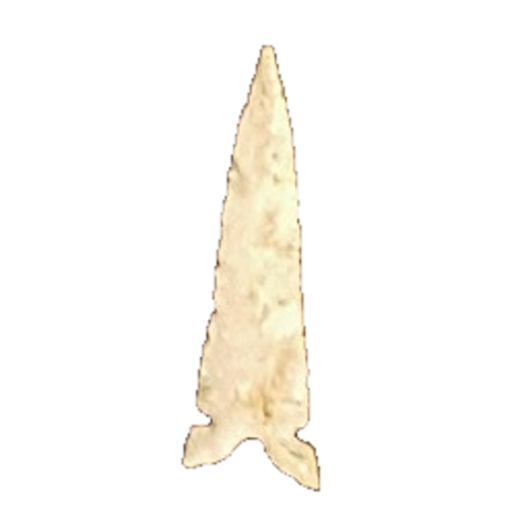
Arrowhead type
Desert Redding Point
Desert ReddingDesert Side Notch Cluster400 - 100 B.P.Historic2 reference photos
Key facts
- Age
- 400 - 100 B.P.
- Cultural period
- Historic
- Culture
- Winitu Culture
- Size
- Small to Medium
- Shape
- Side Notch to Bifurcated
- Material
- Obsidian
- Glacial period
- Little Ice Age to Modern Times
More from the Historic period
Description
This lithic specimen exhibits a slender, triangular morphology with a flattened profile, characterized by a predominantly straight blade that may occasionally exhibit subtle excurvate or incurvate deviations. The blade surface is typically smooth, devoid of serrations, and features diagonal notches positioned below the midpoint, which are notable for their narrow and deep configuration. A distinctive attribute of this point style, referred to as Winitu, is the presence of diagonal notches with a doglegged orientation. The shoulders display variability in their barb formation, ranging from slight to pronounced, contingent upon the notch morphology. The stem expands outward, while the basal edges exhibit a range of configurations, from square to curved, converging towards the base. The base itself can display a deep concavity or a pronounced V-shaped morphology. The flaking pattern observed on this point is random, lacking a discernible order or sequence.
Size
The dimensions of the arrowheads are characterized by the following measurements: overall length ranges from 21 to 142 mm, with a typical average length of 25 to 40 mm. The stem measures between 9 to 13 mm in length. The blade width varies from 12 to 35 mm, while the neck width spans 6 to 18 mm. The basal width is between 12 to 32 mm, and the thickness of the arrowhead ranges from 2 to 7 mm.
Distribution
This type is mainly discovered in the upper Sacramento River valley in central-northern California and extending into the lower Cascade mountains of Oregon.
Mainly found in
Additional information
In the realm of Native American archaeology, a specific type of arrowhead is notable for its distinctive characteristics and cultural associations. The Desert Redding point, also known as the Winitu point, is a significant artifact that sheds light on the technological and artistic prowess of the Winitu culture. One of the defining features of Winitu-made points is the presence of a deeper, narrow dogleg notch, which, despite its unique attributes, still aligns with the broader characteristics of the Desert Redding type.
The classification of the Desert Redding point has been extensively studied, with notable contributions from Martin A. Baumhoff and J.S. Byrne in their 1959 publication. According to their research, the Desert Redding point can be further subdivided into four distinct subtypes: Delta, General (also referred to as the Desert Classic), Redding, and Sierra. These subtypes offer valuable insights into the regional and temporal variations within the Desert Redding point tradition, highlighting the complexity and diversity of Native American arrowhead production.
The Winitu point's association with the Desert Redding type underscores the importance of considering the cultural context in which these artifacts were created. By examining the subtle differences in notch morphology and other characteristics, archaeologists can gain a deeper understanding of the technological, social, and cultural dynamics at play in the lives of the Winitu people and other Native American groups. The study of these arrowheads not only provides a window into the past but also serves as a testament to the ingenuity and craftsmanship of Native American cultures, offering a rich and nuanced perspective on the history of human innovation and expression.
Identified by
- Named by
- Martin A. Baumhoff and J.S. Byrne
- Year
- 1959
Similar types
Types that are easy to confuse with the Desert Redding point.
- Ahsahka
- Bear River
- Bitterroot
- Cold Springs
- Panoche
- Piqunin
- Uinta
Other types in the Desert Side Notch Cluster
- Desert
- Desert Delta
- Yana