
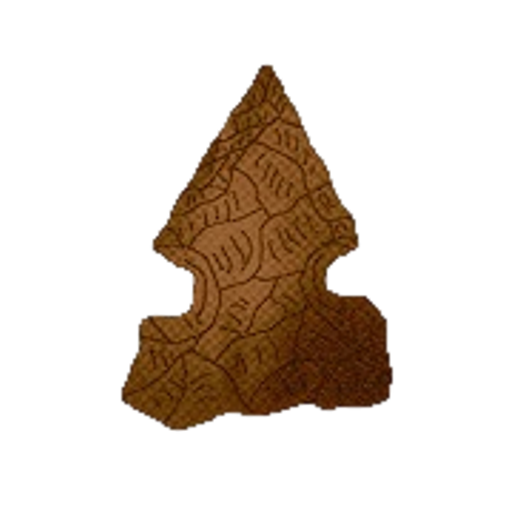
Arrowhead type
Ahsahka Point
Ahsahka4,000 - 3,000 B.P.Middle ArchaicKey facts
- Age
- 4,000 - 3,000 B.P.
- Cultural period
- Middle Archaic
- Size
- Small to Medium
- Shape
- Side Notch
- Glacial period
- Neoglacial
More from the Archaic period
Description
This artifact exhibits a distinctive medium-sized triangular form, characterized by a side notch configuration. The blade profile varies, typically ranging from a straight alignment to a gently outward-curving, or excurvate, shape. Notable are the parallel notches, which are relatively shallow and give rise to subdued, poorly defined shoulders, as well as a stem that broadens towards the base. The basal edge of the point is marked by a convex curvature.
Size
Small to Medium
Distribution
According to Overstreet, this point is located from northern Idaho to eastern Washington
Mainly found in
Additional information
In the realm of Native American arrowhead studies, a particular type has garnered attention despite the scarcity of professional references. Notably, the renowned expert Overstreet has provided valuable insights into this enigmatic type, which serves as the primary source of information. According to Overstreet's findings, this distinct arrowhead type appears to have evolved from two preceding forms: the Hatwai and Cold Springs types. This evolutionary link suggests a fascinating narrative of technological and cultural development among the indigenous populations that crafted these artifacts.
The association with the Hatwai and Cold Springs types implies a rich cultural heritage, as these earlier forms are well-documented in the archaeological record. By examining the characteristics of this newly identified type, researchers can gain a deeper understanding of the innovative processes and traditions that defined the lives of Native American communities. Although the lack of extensive professional references may limit our current knowledge, Overstreet's contributions have shed crucial light on this subject, inviting further investigation and analysis.
As scholars continue to explore the history and significance of this arrowhead type, they may uncover additional details about its distribution, chronology, and functional context. The fact that Overstreet's work has been instrumental in shaping our understanding of this type underscores the importance of meticulous research and documentation in the field of archaeology. By building upon these foundational findings, future studies can refine our comprehension of Native American technological and cultural developments, ultimately enriching our appreciation for the complexities and diversities of indigenous societies.
Similar types
Types that are easy to confuse with the Ahsahka point.
- Kamloops Side Notch
- Piqunin
- Salish Side Notch