
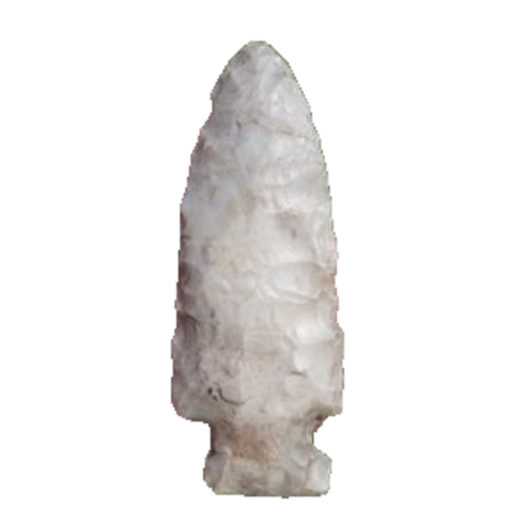
Arrowhead type
Cold Springs Point
Cold SpringsNorthern Side Notch Cluster6,700 - 5,000 B.P.Late Prehistoric to Developmental2 reference photos
Key facts
- Age
- 6,700 - 5,000 B.P.
- Cultural period
- Late Prehistoric to Developmental
- Size
- Small to Medium
- Shape
- Side Notch
- Material
- Obsidian
- Glacial period
- Middle Holocene
More from the Late Prehistoric, Developmental periods
Description
This triangular side notch point exhibits a compact to moderate size profile, characterized by an elliptical cross-sectional shape. The blade's curvature can range from a subtle excurvate shape to a straight alignment, while the shoulders may display a horizontal orientation or a slight, upward inclination. The stem expands in width, and in such cases, the basal margin is often narrowed. Conversely, the basal margin can also appear straight or slightly contracting on other specimens. The base of the point typically presents a straight edge, although it may occasionally exhibit a subtle convex or concave curvature. The flaking pattern on this point is random, lacking a discernible, organized arrangement.
Size
The dimensions of the arrowheads are as follows: they exhibit a total length range of 28 to 114 mm, with a mean length typically falling between 40 to 60 mm. The stem measures between 11 to 16 mm in length. In terms of width, the blade spans 16 to 34 mm, while the neck and stem widths are 10 to 17 mm and 14 to 33 mm, respectively. The thickness of the arrowheads varies from 4 to 8 mm.
Distribution
This type is mainly discovered in the Columbia Plateau region of Washington, Oregon, and northern Idaho, extending into the Canadian Plateau area of British Columbia
Mainly found in
Also found, less often, in
Additional information
In the realm of Native American arrowhead typology, the Northern Side Notch, Bitterroot Side Notch, and Cold Springs point types exhibit a notable degree of overlap in their characteristics. This similarity has led to confusion among researchers, as highlighted by Homer's 1980 study, which critiques the inconsistent application of these typological distinctions. One approach to differentiating between these point types is based on their geographic distribution, with the Cold Springs type commonly found on the Columbia Plateau, the Bitterroot type associated with the Northern Plains and extending into the Northern Great Basin.
A closer examination of the morphometric attributes of these point types reveals that the distinctions between them may be more nuanced than previously thought. Homer's comprehensive analysis, which involved a rigorous battery of measurements, failed to uncover any significant distinguishing characteristics that would unequivocally set these types apart from one another. This finding suggests that the traditional typological boundaries between the Northern Side Notch, Bitterroot Side Notch, and Cold Springs point types may be more fluid than initially assumed, and that a more nuanced understanding of the cultural and historical contexts in which these points were produced is necessary to fully appreciate their significance.
The overlap between these point types underscores the complexity and diversity of Native American lithic technology, highlighting the need for a more refined and contextualized approach to understanding the archaeological record. By recognizing the limitations of traditional typological classifications, researchers can work towards a more nuanced understanding of the cultural and historical factors that shaped the development of these point types, and ultimately gain a deeper appreciation for the technological and artistic achievements of Native American communities in the region.
Identified by
- Named by
- J. L. Shiner
- Year
- 1961
- Type site
- Cold Springs Site, McNary Reservoir, Oregon
Similar types
Types that are easy to confuse with the Cold Springs point.
- Bitterroot
- Diablo Canyon
- Northern
- Salmon River
Other types in the Northern Side Notch Cluster
- Elko Side Notch
- Northern Side Notch
- San Rafael
- Sudden Shelter
- Ventana Side Notch