
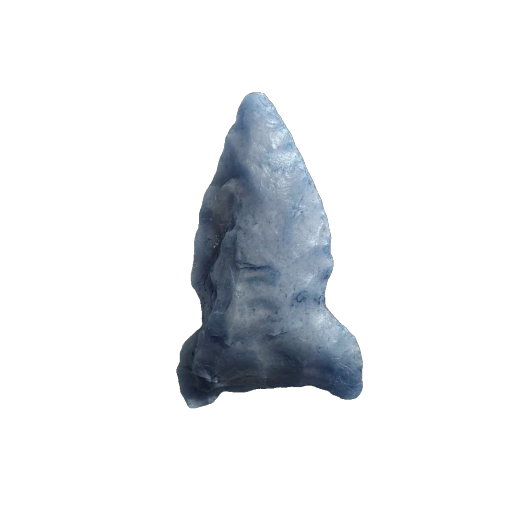
Arrowhead type
Desert Delta Point
Desert DeltaDesert Side Notch Cluster500 - 200 B.P.Historic18 reference photos
Key facts
- Age
- 500 - 200 B.P.
- Cultural period
- Historic
- Culture
- Maidu, Miwok, Washoe, Yokut and other cultures
- Size
- Small
- Shape
- Side Notch to Bifurcated
- Material
- Obsidian
- Glacial period
- Little Ice Age
More from the Historic period
Description
This projectile point exhibits a slender, triangular profile with a flattened cross-sectional morphology, characterized by a predominantly straight blade that may occasionally exhibit a subtle excurvate curvature. Notably, the blade surface is typically smooth, devoid of serrations. The parallel notches are positioned relatively low on the point, below the midpoint, and are distinguished by their narrow, deep configuration, often resulting in a constricted neck. The shoulders are oriented horizontally, merging with an expanded stem. The basal margin is commonly demarcated by a squared edge, transitioning into a concave to V-shaped base. The point's manufacture involves the removal of percussion flakes, followed by shaping and finishing via pressure flaking, yielding a random, irregular flaking pattern.
Size
The arrowheads exhibit a range of dimensions, with total lengths spanning 9 to 40 mm, and averaging between 17 and 26 mm. The stem portion measures between 6 and 9 mm in length. In terms of width, the blade ranges from 5 to 15 mm, with an average width of 8 to 12 mm. The neck width varies from 5 to 10 mm, with a mean of 7 mm. The basal width is between 10 and 19 mm, while the overall thickness of the arrowheads falls within the range of 2 to 4 mm.
Distribution
This type is mainly discovered in the Sacramento Delta and extending into the Bay area, but can also be located from the Columbia River Valley in Oregon into the Great Basin.
Additional information
In the context of Native American arrowheads, a notable observation is the relatively low frequency of a particular point type within the cultural regions associated with the Fremont tradition. This phenomenon is significant, as it suggests a shift in technological or stylistic preferences over time. According to Justice (2002), the points from this specific cluster appear to have supplanted those from the Rosegate Cluster, indicating a potential evolution in arrowhead design or function.
Further insight into the characteristics of this point type is provided by the work of Martin A. Baumhoff and J.S. Byrne (1959), who identified four distinct subtypes. These subtypes, namely Delta, General (also referred to as Desert Classic), Redding, and Sierra, demonstrate a range of variations within this point type. The recognition of these subtypes highlights the complexity and diversity of arrowhead designs, even within a single cultural or technological tradition. By examining these subtypes, researchers can gain a deeper understanding of the technological, social, and cultural factors that influenced the development and use of arrowheads in different regions and contexts.
The identification and analysis of these subtypes also underscore the importance of meticulous classification and documentation in archaeology. By distinguishing between different point types and subtypes, researchers can reconstruct the technological and cultural trajectories of past societies, shedding light on the dynamics of human innovation, adaptation, and exchange. In this case, the study of this particular point type and its subtypes contributes to a broader understanding of the archaeological record, illuminating the lives and traditions of Native American communities in the region.
Identified by
- Named by
- Martin A. Baumhoff
- Year
- 1959
Similar types
Types that are easy to confuse with the Desert Delta point.
- Ahsahka
- Bear River
- Bitterroot
- Cold Springs
- Panoche
- Piqunin
- Uinta
Other types in the Desert Side Notch Cluster
- Desert
- Desert Redding