
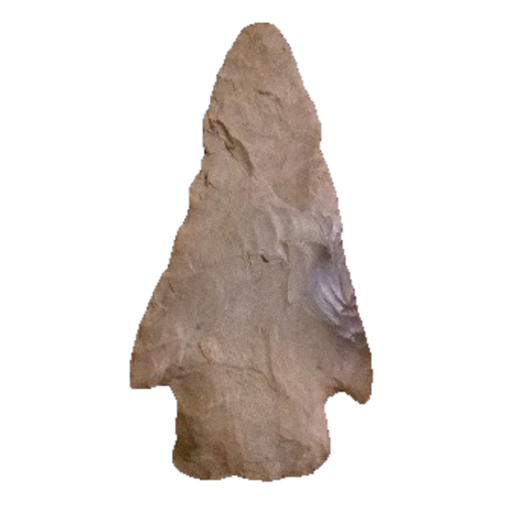
Arrowhead type
Cypress Creek Expanding Stem Point
Cypress Creek Expanding StemEva Cluster7,500 - 6,000 B.P.Early Archaic3 reference photos
Key facts
- Age
- 7,500 - 6,000 B.P.
- Cultural period
- Early Archaic
- Size
- Medium to Large
- Shape
- Expanding Stem to Corner Notch
- Glacial period
- Middle Holocene
More from the Archaic period
Description
This triangular point exhibits a distinctive morphology, characterized by a medium to large size and an elliptical cross-sectional profile. The blade's curvature is predominantly excurvate, although resharpening can result in a straighter edge in some instances. Notably, the shoulders display a barbed morphology with a pronounced, downward-sloping orientation. The blade itself is broad and features beveling on all four edges, imparting a sharp, angular appearance. The stem is expansive and broad, tapering to a base that is generally straight, yet can exhibit subtle variations ranging from slightly concave to slightly convex. The flaking pattern observed on the blade is random, with no discernible order or orientation, adding to the point's overall complexity.
Size
The dimensions of the arrowheads are characterized by the following measurements: overall length ranges from 50 to 130 mm, while the stem length varies between 9 and 17 mm. The width of the blade spans 29 to 43 mm, with the neck width and basal width measuring between 17 to 28 mm and 16 to 28 mm, respectively. These measurements are based on a limited dataset.
Distribution
This projectile is predominantly located in the Tennessee River basin. Its presence is less frequent in the central to northern Ohio River basin and extends into southwestern Virginia, North Carolina, South Carolina, and Georgia
Also found, less often, in
Additional information
In their seminal 1961 study, Lewis and Lewis conducted an in-depth examination of the Eva Site, located in Benton County, Tennessee. Their research yielded the identification of four distinct variants of arrowhead points, which they subsequently categorized into two pairs: Eva Type I and Eva Type II, as well as Cypress Creek Type I and Cypress Creek Type II. Notably, however, the latter variant, Cypress Creek Type II, was not thoroughly described in their work, a omission that was later highlighted by Nance in 1986.
Further investigation at the Morrisroe Site revealed the co-occurrence of these points with both Eva and Kirk Corner Notch points, suggesting a potential cultural or temporal overlap. A closer analysis of the point characteristics revealed that they exhibit a mix of traits, effectively bridging the stylistic gap between the Eva and Kirk Corner Notch points. This intermediate positioning is a significant finding, as it implies a possible transitional phase or cultural exchange, as noted by Nance in 1986. The discovery of these points in association with other diagnostic artifacts provides valuable insights into the technological and cultural developments of the region's prehistoric inhabitants.
It is essential to distinguish the Cypress Creek points found at the Eva and Morrisroe Sites from the similarly named points originating from the Gulf Coastal region, as they are not related. This distinction is crucial for maintaining accuracy in the classification and interpretation of these archaeological findings. By recognizing the unique characteristics and cultural context of the Cypress Creek points, researchers can continue to refine our understanding of the complex cultural dynamics and technological innovations that defined the lives of Native American communities in the region.
Identified by
- Named by
- T. M. N. Lewis and Madeline Kneberg
- Year
- 1960
- Type site
- Eva Site, Benton County, Tennessee
Similar types
Types that are easy to confuse with the Cypress Creek Expanding Stem point.