
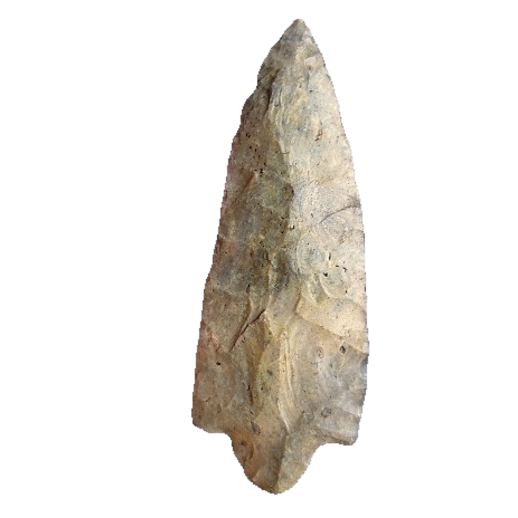
Arrowhead type
Cypress Creek Contracting Stem Point
Cypress Creek Contracting Stem4,000 - 3,000 B.P.Late Archaic to Early Woodland29 reference photos
Key facts
- Age
- 4,000 - 3,000 B.P.
- Cultural period
- Late Archaic to Early Woodland
- Size
- Medium to Large
- Shape
- Contracting Stem
- Glacial period
- Neoglacial
Description
This triangular point measures between 2.0 to 3.5 inches in length and exhibits a contracting stem, accompanied by an elliptical cross-sectional profile. The blade edge varies in curvature, ranging from excurvate to straight, while the shoulders display a range of orientations, from horizontal to slightly barbed. Notably, the shoulders often exhibit subtle asymmetry, with one shoulder positioned slightly higher and featuring a narrower stem-blade margin, whereas the opposing shoulder sits lower, boasting a wider margin and occasionally curving inward toward the base. The stem itself is short and contracting, terminating in a convex base. The flaking pattern on this point is random, yet the overall workmanship is of high quality, demonstrating a skilled level of craftsmanship.
Size
The arrowheads exhibit the following dimensional characteristics: overall length ranges from 50 to 90 mm, with a mean length typically falling between 65 to 75 mm. The stem segment measures between 10 to 15 mm in length. In terms of width, the blade spans 35 to 50 mm, averaging 40 to 45 mm, while the stem width is between 15 to 20 mm.
Distribution
This type is mainly discovered in the Tampa region and extends into neighboring territories.
Mainly found in
Additional information
In the realm of Native American archaeology, it is essential to distinguish between various types of projectile points, each with its unique characteristics and cultural associations. Notably, the point in question does not share any affinity with the Cypress Creek point, a distinct type of arrowhead found in the Tennessee River Valley. This clarification is crucial in understanding the diversity of prehistoric technologies and the geographic distribution of different cultural groups.
The Cypress Creek point, specifically, is a significant find within the Tennessee River Valley, an area renowned for its rich archaeological heritage. By recognizing the differences between this point and others, researchers can gain valuable insights into the lives and traditions of the indigenous peoples who crafted these tools. The absence of a connection between the point in question and the Cypress Creek point highlights the complexity and variability of Native American technological and cultural expressions.
Through careful analysis and comparison of various projectile points, archaeologists can reconstruct the histories and migrations of ancient cultures, shedding light on the intricate relationships between different groups and their environments. In this context, the point in question, unrelated to the Cypress Creek point, presents an opportunity for further investigation and exploration, potentially revealing new information about the cultural and technological practices of Native American communities in the region.
Identified by
- Named by
- Son Anderson
- Year
- 1987
Similar types
Types that are easy to confuse with the Cypress Creek Contracting Stem point.
- Alachua
- Hillsborough
- Levy
- Morrow Mountain
- Sumter
Other types in this cluster
- Hardee
- Newnan
- Thonotosassa