
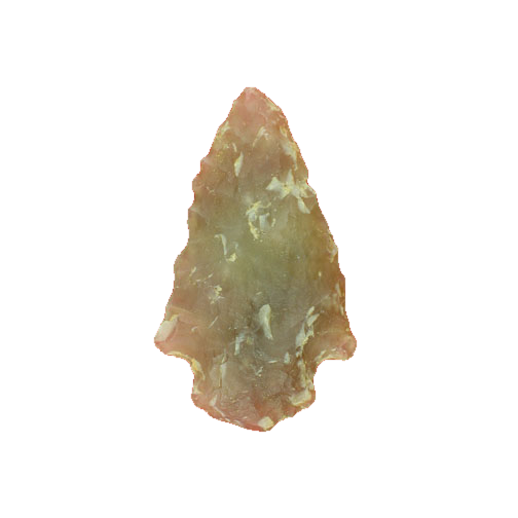
Arrowhead type
Coosa Stemmed Point
Coosa Stemmed2,000 - 1,500 B.P.WoodlandKey facts
- Age
- 2,000 - 1,500 B.P.
- Cultural period
- Woodland
- Size
- Medium
- Shape
- Straight Stem to Contracting Stem
- Material
- Pottery
- Glacial period
- Roman Warm
More from the Woodland period
Description
This triangular point exhibits a robust profile, measuring between 1.25 to 2 inches in thickness. In cross-section, it typically presents an elliptical shape, although some specimens may display unifacial or flattened profiles. The blade often exhibits asymmetry, characterized by an excurvate shape, and may feature beveling. The shoulder morphology is predominantly angled upwards, but can occasionally be oriented horizontally or even exhibit a slight barb. The stem varies in form, ranging from straight to slightly tapering. The basal edge is generally straight, with some instances showing a subtle convex curvature. The flaking pattern is predominantly random, although a small number of specimens exhibit transverse oblique flaking. Overall, the craftsmanship of these points is often coarse, suggesting a more expedient manufacturing approach.
Size
The dimensions of the arrowheads are as follows: - The overall length ranges from 28 to 47 mm, with an average length of 37 to 39 mm. - The stem measures between 4 and 12 mm in length, averaging 6 to 7 mm. - The blade width varies from 14 to 23 mm, with an average width of 17 to 22 mm. - The width of the stem is between 10 and 14 mm, averaging 11 to 12 mm. - The thickness of the arrowhead is between 7 and 8 mm.
Distribution
This type is mainly located in the Coosa River area, yet can also be discovered in the Tennessee River Valley spanning southern Tennessee, northern Alabama, and extending into northeastern Mississippi and northwestern Georgia
Additional information
In a notable observation, researcher Whatley (2002) cites a personal communication with George Price, which sheds light on the temporal context of Coosa Notched and Coosa Stemmed points. According to Price, these point types are frequently discovered in association with Late Cartersville and Swift Creek ceramics in the northwestern region of Georgia. This significant finding suggests that the Coosa Notched points have a chronological range that extends into the Middle Woodland period. As a result, archaeologists estimate that these points were produced over a broad timeframe, spanning from approximately 2500 to 1500 years before present (BP). This extended period highlights the enduring presence of Coosa Notched points in the regional archaeological record, underscoring their importance as a diagnostic tool for understanding the cultural and technological developments of the Middle Woodland period in northwestern Georgia.
Identified by
- Named by
- David DeJannette
- Year
- 1973
- Type site
- Coker Ford Site, Coosa River, Cherokee County, Alabama
Similar types
Types that are easy to confuse with the Coosa Stemmed point.
- Bradley Spike
- Hamilton Stemmed
- Pontchartrain Type I
- South Creek Pronged
Other types in this cluster
- Coosa Notched
- Triangular Copena
- Greenville
- Nolichucky