
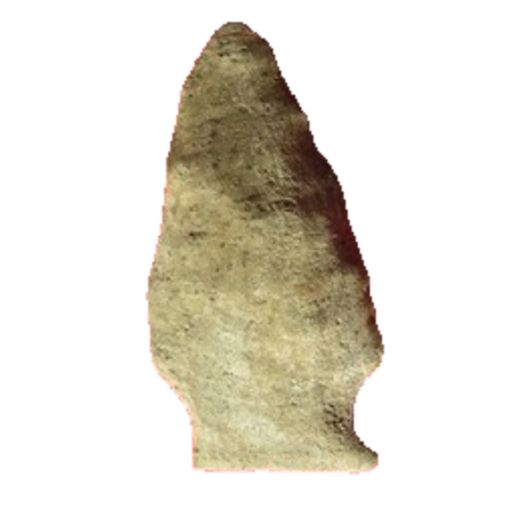
Arrowhead type
Brewerton Side Notch Point
Brewerton Side NotchMatanzas Cluster5,000 - 4,000 B.P.Early Archaic25 reference photos
Key facts
- Age
- 5,000 - 4,000 B.P.
- Cultural period
- Early Archaic
- Culture
- Brewerton Culture
- Size
- Small to Medium
- Shape
- Side Notch
- Material
- Jasper
- Glacial period
- Middle Holocene to Neoglacial
More from the Archaic period
Description
This medium-sized point exhibits an elliptical profile in cross-section. The blade morphology varies, typically presenting an excurvate shape, although straight and incurvate forms also occur. Fine serrations may be present along the blade edge. The stem is characterized by parallel notches that produce a horizontal orientation, often accompanied by an expanding shape. In some instances, double notches are observed. The basal edge is generally straight, but can occasionally display slight concavity or convexity, and may feature basal grinding. The overall flaking pattern on this point appears to be random.
Size
The arrowheads exhibit a range of dimensions, with lengths spanning 21 to 98 mm, and an average length of 32 to 57 mm. The stem of the arrowhead measures between 7 and 14 mm in length. In terms of width, the blade ranges from 18 to 40 mm, while the neck width is between 13 and 18 mm. The stem width varies from 10 to 22 mm, and the overall thickness of the arrowhead is between 6 and 12 mm.
Distribution
The Brewerton Complex points are mainly concentrated in the northeast region and extend into the Ohio River basin. They have also been identified in the Tennessee River Valley and middle to southern Mississippi River valley, albeit less commonly.
Mainly found in
Also found, less often, in
Additional information
The origins and usage of the Brewerton series arrowheads have been a subject of debate among archaeologists. Richie's 1971 study posits that these particular points represent the earliest examples within the series, whereas other researchers suggest that they may have been utilized concurrently with other types. Notably, the geographic distribution of these points is predominantly concentrated in the Ohio River Valley and extending eastward. A significant number of these artifacts have been unearthed at sites situated within the Tennessee River Basin, including the notable Etowah River site in Georgia and the Cave Spring site in Alabama, as documented by Cambron in 1964. These findings underscore the importance of continued research into the chronology and cultural associations of the Brewerton series, highlighting the complex and nuanced history of Native American arrowhead technology.
The presence of these points at specific sites, such as the Etowah River and Cave Spring sites, provides valuable insights into the cultural and geographic contexts in which they were used. The Tennessee River Basin, in particular, emerges as a significant region for the study of Brewerton series arrowheads, with these sites offering a unique window into the lives and traditions of the Native American communities that once inhabited this area. By examining the distribution and characteristics of these points, archaeologists can gain a deeper understanding of the technological, social, and cultural developments that shaped the lives of these ancient communities.
Further analysis of the Brewerton series, including the points found in the Ohio River Valley and the Tennessee River Basin, can shed light on the migration patterns, trade networks, and cultural exchange that occurred among Native American groups in this region. The work of researchers like Richie and Cambron has laid the foundation for continued exploration into the history and significance of these arrowheads, inviting further investigation into the complexities of Native American technology, culture, and society.
Identified by
- Named by
- William Richie
- Year
- 1961
- Type site
- Robinson Site, Onondaga County, New York
Similar types
Types that are easy to confuse with the Brewerton Side Notch point.
- Big Sandy
- Black Sand
- Godar
- Meadowood
- Otter Creek
- Susquehanna Broad