
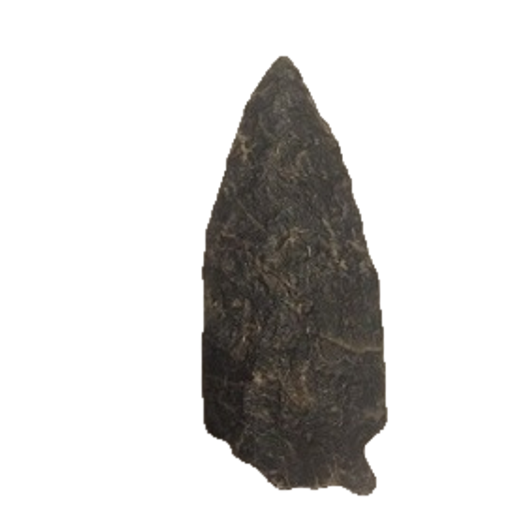
Arrowhead type
Sonota Point
Sonota1,950 - 1,350 B.P.Developmental to Woodland7 reference photos
Key facts
- Age
- 1,950 - 1,350 B.P.
- Cultural period
- Developmental to Woodland
- Culture
- Sonota Culture
- Size
- Medium
- Shape
- Side Notch
- Material
- Flint
- Glacial period
- Roman Warm to Scandic Period
More from the Woodland, Developmental periods
Description
This projectile point exhibits a slender, triangular to lanceolate silhouette with a side notch configuration, characterized by a thin, elliptical cross-sectional profile. The blade's morphology is marked by an excurvate shape, where the tip curves inward before recurving back towards the shoulders, although some specimens may display a straighter blade profile. The parallel notches are notably broad and situated low on the blade, resulting in weak, upward-angled shoulders and an expanding stem. The basal edge can vary from straight to subtly concave. Overall, this point type is often meticulously crafted, featuring a random flaking pattern that suggests a high degree of technical proficiency.
Size
The dimensions of the arrowheads are as follows: they range in overall length from 26 to 67 mm, with stem lengths varying between 4 and 7 mm. The width of the blade spans from 11 to 26 mm, while the neck width measures between 8 and 13 mm.
Distribution
These artifacts are predominantly located in the southern area of the Besant cultural sphere, which overlaps with the Sonota cultural influence (red). They can also be discovered within the same geographic range as the Besant type, albeit at a lower occurrence rate (yellow)
Mainly found in
Additional information
In the realm of Native American archaeology, the classification of certain arrowhead types has been a subject of interest among researchers. Notably, Peck (2011) observes that larger Samantha points can be categorized under a specific type, highlighting the complexities of point typology. Furthermore, it has been noted that Sonota points often exhibit characteristics that lead to their classification as both Besant and Samantha points, underscoring the nuances of archaeological taxonomy.
The Sonota Culture, as identified by Everitt et al. (1996), is considered a sub-culture of the broader Besant culture. This relationship is significant, as it implies that Sonota points may be found in conjunction with Besant points, although their distribution patterns differ. Specifically, Sonota points are more commonly encountered in the southern regions, as opposed to their Besant counterparts. This distinction is crucial for understanding the spatial and cultural contexts in which these points were used.
It is also worth noting that collectors have adopted the term "Deep Water Creek" to describe a particular type of point found in North Dakota and Montana. Although this designation is not formally recognized in professional archaeological literature, it highlights the importance of considering the regional distribution and cultural associations of these points. By examining the characteristics and distribution patterns of these arrowhead types, researchers can gain valuable insights into the lives and traditions of the Native American communities that created them, ultimately enriching our understanding of the region's rich cultural heritage.
Identified by
- Named by
- Leigh E. Syms
- Year
- 1977
Similar types
Types that are easy to confuse with the Sonota point.
- Avonlea Carmichael
- Avonlea Gulf Lake
- Avonlea Timber Ridge
- Besant
- Little Sioux
- Nanton
- Samantha
Other types in this cluster
- Sandy Creek
- Pelican Lake