
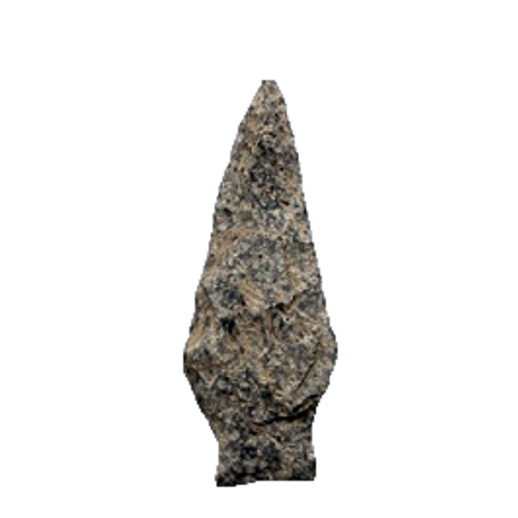
Arrowhead type
Forest Point
ForestSusquehanna Cluster3,100 - 2,500 B.P.Early Woodland3 reference photos
Key facts
- Age
- 3,100 - 2,500 B.P.
- Cultural period
- Early Woodland
- Size
- Medium
- Shape
- Expanding Stem to Side Notch
- Material
- Pottery
- Glacial period
- Neoglacial
More from the Woodland period
Description
This triangular point exhibits a distinctive morphology, characterized by a medium-sized expanding stem and an elliptical cross-sectional profile. The blade edge is predominantly straight, although it may occasionally display a subtle excurvate curvature. The shoulders are positioned at an upward angle, typically terminating in a rounded junction where they converge with the blade. The stem itself is marked by a gradual expansion, culminating in a base that is either straight or slightly concave. The flaking pattern observed on this point is random, lacking a discernible organizational structure.
Size
Medium
Distribution
This type is mainly located in the northern Ohio River region.
Mainly found in
Additional information
The arrowhead in question is believed to have originated from the same time period as the Fishtail Complex, a notable archaeological phenomenon. Specifically, it is thought to represent a regional variation characteristic of the Upper Ohio Valley. This classification is supported by the Pennsylvania Archaeological Society, which has extensively studied the Fishtail Complex and its various manifestations across different geographic areas. The Upper Ohio Valley variant is distinguished by unique features that set it apart from other regional expressions of the Fishtail Complex, highlighting the diversity and complexity of prehistoric cultural developments in this part of North America.
Identified by
- Named by
- William J. Mayer-Oakes
- Year
- 1955
- Type site
- Siggins Site (36Fo1), Allegheny River, Pennsylvania
Similar types
Types that are easy to confuse with the Forest point.
- Dry Brook Fishtail
- Orient Fishtail
Other types in the Susquehanna Cluster
- Ashtabula
- Dismal Swamp
- Drybrook
- Perkiomen
- Susquehanna Broad Spear
- Wayland