
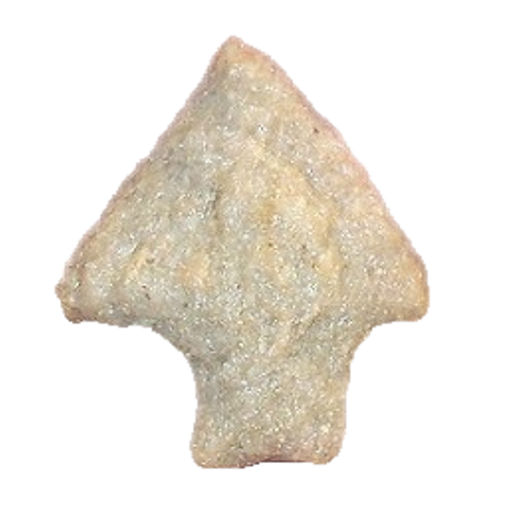
Arrowhead type
Dismal Swamp Point
Dismal SwampSusquehanna Cluster3,500 - 3,000 B.P.Late Archaic to Early WoodlandKey facts
- Age
- 3,500 - 3,000 B.P.
- Cultural period
- Late Archaic to Early Woodland
- Size
- Medium
- Shape
- Straight Stem
- Glacial period
- Neoglacial
Description
This triangular point exhibits a distinctive asymmetrical morphology, characterized by a broad, medium-sized blade with a flattened cross-sectional profile. The blade's edge profile can range from straight to excurvate, displaying a subtle curvature. The shoulders of the point are notable for their barbed appearance, although they can exhibit a degree of asymmetry, with one shoulder featuring a horizontal or downward-sloping orientation, while the other shoulder typically slopes upward. The stem of the point can vary in shape, ranging from straight to slightly expanding, and the base can display a range of forms, from straight to concave. Evidence of grinding is often observed on the hafting area, suggesting deliberate shaping for attachment. The flaking pattern on this point is random, lacking a consistent or organized arrangement of flake scars.
Size
Medium
Distribution
This type is mainly discovered in southern Virginia's eastern areas and northern North Carolina (Dismal Swamp area).
Mainly found in
Additional information
The archaeological specimen in question is believed to represent a localized variation of the Perkiomen point, a distinct type of projectile point associated with Native American cultures. This classification is significant, as the Perkiomen point is a well-documented and recognizable form, characterized by its unique morphology and distribution. Further analysis of the point's characteristics, such as its size, shape, and material composition, would be necessary to confirm its classification and shed light on its potential origins and cultural context.
Notably, the Perkiomen point is named after the Perkiomen Creek in Pennsylvania, where numerous examples of this point type have been found. The presence of similar points in other regions suggests a broader geographic distribution, potentially indicating trade networks or cultural exchange between Native American groups. The study of regional variants, such as the one in question, can provide valuable insights into the technological, social, and economic dynamics of these ancient cultures. By examining the subtle differences and similarities between these variants, researchers can reconstruct a more nuanced understanding of the complex cultural landscape of Native American societies.
A detailed examination of the point's morphology, including its measurements and stylistic features, would be essential to determining its precise classification and significance within the context of Native American archaeology. This analysis would involve comparing the point to established typologies and considering its potential relationships to other known point types, such as the Perkiomen point. Ultimately, a thorough understanding of this regional variant can contribute to a richer understanding of the cultural and historical contexts in which it was created and used.
Identified by
- Named by
- Floyd Painter
- Year
- 1963
Similar types
Types that are easy to confuse with the Dismal Swamp point.