
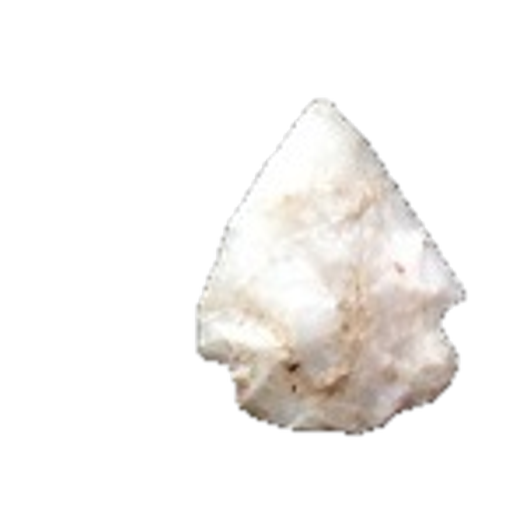
Arrowhead type
Klunk Point
KlunkLate Woodland Stemmed Cluster to Late Woodland Corner Notch Cluster1,500 - 1,000 B.P.Woodland2 reference photos
Key facts
- Age
- 1,500 - 1,000 B.P.
- Cultural period
- Woodland
- Size
- Small
- Shape
- Side Notch to Expanding Stem
- Glacial period
- Roman to Medieval Warm
More from the Woodland period
Description
This diminutive side-notched projectile point exhibits a compressed cross-sectional profile. The blade's longitudinal axis is generally linear, although it may display a subtle outward curvature. Notable for its prominent, parallel notches of moderate to large size, the shoulder forms a distinct angle, ranging from horizontal to upwardly inclined. The stem's morphology is characterized by an expanding to fully expanded form. The basal edge is typically straight, but may also be convex in some instances. Occasional evidence of basal grinding is observed on this point type. The flaking pattern is random and non-directional. In some cases, this point may be fashioned from a single flake, resulting in a unifacial implement.
Size
Small
Distribution
This type is mainly discovered in the upper Mississippi River region and extends into eastern Iowa. It is less frequently encountered in western Wisconsin and eastern Minnesota.
Also found, less often, in
Additional information
In his 1971 publication, Perino proposed a sequential development of certain point types, suggesting a chronological progression from side-notched to corner-notched, and ultimately to spike-like points. This evolutionary trajectory implies a gradual shift in design, potentially driven by technological innovations, changes in hunting strategies, or cultural exchange. By examining the morphological characteristics of these points, researchers can gain insight into the technological and cultural adaptations of the societies that created them. The side-notched points, with their distinctive notches located on the sides of the blade, likely preceded the corner-notched types, which feature notches positioned at the corners of the point. The subsequent emergence of spike-like points, with their elongated, tapering forms, may have marked a significant departure from earlier designs, potentially reflecting changes in weaponry, hunting practices, or social dynamics.
Perino's proposed sequence highlights the importance of considering the diachronic context of archaeological artifacts, as the development of point types can provide a window into the cultural, technological, and environmental factors that shaped the lives of past societies. The progression from side-notched to corner-notched to spike-like points may have been influenced by a variety of factors, including the availability of raw materials, the development of new tool-making techniques, and the exchange of ideas between different cultural groups. By analyzing the characteristics of these point types and their distribution across time and space, archaeologists can reconstruct a more nuanced understanding of the complex historical processes that shaped the lives of Native American communities.
The study of point types, such as those described by Perino, offers a unique perspective on the cultural and technological developments of Native American societies. By examining the design, manufacture, and use of these artifacts, researchers can gain a deeper understanding of the social, economic, and environmental contexts in which they were created. The progression from side-notched to corner-notched to spike-like points serves as a testament to the ingenuity and adaptability of Native American cultures, highlighting the complex and dynamic nature of their technological and cultural traditions.
Identified by
- Named by
- Gregory Perino
- Year
- 1971
- Type site
- Klunk Mound Site, Calhoun County, Illinois
Similar types
Types that are easy to confuse with the Klunk point.