
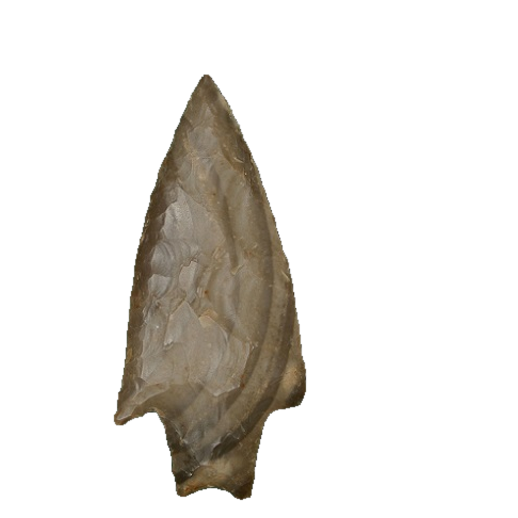
Arrowhead type
Austin Point
Austin4,800 - 4,500 B.P.Late Archaic2 reference photos
Key facts
- Age
- 4,800 - 4,500 B.P.
- Cultural period
- Late Archaic
- Size
- Medium to Large
- Shape
- Contracting Stem
- Glacial period
- Middle Holocene
More from the Archaic period
Description
This stemmed triangular point exhibits a size range from medium to large, characterized by an elliptical cross-sectional profile. The blade's curvature is predominantly excurvate, although it can transition to a straight or incurvate shape in instances where the point has undergone extensive re-sharpening. A distinctive bevel is present along the left edge of both faces. The shoulders display barbed morphology, which may degrade to a weaker, more horizontal orientation in cases where the point has been heavily re-sharpened. The stem tapers slightly, terminating in a base that is subtly concave. The flaking pattern observed on this point is random, lacking a discernible order or organization.
Size
The dimensions of the arrowheads are as follows: they range in overall length from 45 to 110 mm, with stem lengths varying between 12 and 19 mm. The width of the blade spans from 23 to 40 mm, while the stem width at the shoulder joint measures between 14 and 19 mm. Additionally, the basal width is recorded to be within the range of 10 to 15 mm.
Distribution
This type is mainly discovered in the low-lying areas encircling Houston and extending into the southern grasslands near San Antonio
Additional information
The Austin arrowhead type, characterized by its contracted stem, was first identified and named by Dwain Rogers, a renowned amateur archaeologist and artifact authenticator. Rogers' classification was based on specimens unearthed at the Goebel site, situated between Austin and Houston, Texas. Notably, Austin arrowheads exhibit a wide range of sizes, spanning from 2 to 5 inches in length, and typically feature a distinctive left-side bevel on each face. Additionally, their stems contract towards the base, which is often slightly to moderately concave.
The temporal context of the Austin arrowhead places it within the Middle Archaic period, a significant timeframe in the cultural and technological development of Native American societies. Geographically, the distribution of Austin arrowheads is currently limited to the central Coastal Plains region, with a specific concentration between Houston and San Antonio, Texas. This restricted distribution pattern suggests that the Austin type may have been preferred or exclusively used by certain Native American groups within this region.
Rogers' 2008 reference provides a foundational framework for understanding the Austin arrowhead type, highlighting its unique characteristics and cultural associations. Further research and excavation may shed more light on the significance and usage of this distinctive arrowhead type, offering valuable insights into the lives and traditions of the Native American communities that crafted and utilized them. As an important part of the archaeological record, the Austin arrowhead continues to contribute to our understanding of the complex and diverse cultural heritage of Native American societies in North America.
Identified by
- Named by
- Dwain Rodgers
- Year
- 2008
Similar types
Types that are easy to confuse with the Austin point.