
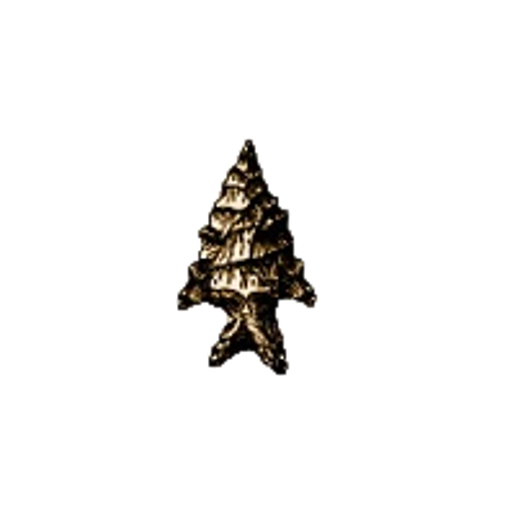
Arrowhead type
Alazan Point
AlazanLivermore Stemmed Cluster850 - 650 B.P.Late PrehistoricKey facts
- Age
- 850 - 650 B.P.
- Cultural period
- Late Prehistoric
- Culture
- Livermore culture
- Size
- Medium
- Shape
- Expanding Stem to Bifurcated
- Material
- Glass
- Glacial period
- Medieval Warm
More from the Late Prehistoric period
Description
This diminutive point, measuring between 1 to 1.25 inches in length, exhibits a triangular form with a bifurcated and expanding stem. Its cross-sectional profile is characterized by a flattened shape. The blade itself is generally straight, although its curvature can vary, ranging from excurvate to incurvate or recurvate configurations. Serrations on the blade are typically pronounced, spanning from fine to deep. The apex of the point often features a beveled edge, sometimes imparting a needle-like appearance. The shoulders are distinguished by barbed formations, which merge with a relatively short expanding stem in relation to the blade's length. A notched and bifurcated base marks the terminus of the point. The flaking pattern observed on this specimen is random, lacking a discernible order or sequence.
Size
The arrowheads exhibit the following dimensional characteristics: overall length ranges from 15 to 35 mm, while the stem length varies between 4 to 70 mm. The width of the blade is measured between 12 to 15 mm, and the neck width is narrower, spanning 4 to 6 mm. At the base, the width is recorded as 6 to 10 mm, with these measurements derived from a limited dataset.
Distribution
This arrowhead type is mainly discovered in the eastern Trans Pecos area and the Big Bend area of Texas. Mallouf (2013) observes that this style is present in the Terlingua Creek, Bear Creek, Glass Mountains, Big Canyon, Chisos Mountains, Maravillas Creek, and Persimmon Gap locales of the Big Bend Proper.” He also observes that they “seem to have a rising occurrence to the north, being found in the Davis Mountains, Y-6 Hills, Lobo Valley, and Plateau regions.” and into the Guadalupe Mountains, Delaware Mountains, and Salt Basin regions
Mainly found in
Additional information
In the realm of Native American archaeology, the Alazan arrowhead type holds significant importance, particularly in the context of the American Southwest. The term "Alazan" is derived from the Spanish word for "sorrel," a plant characterized by its arrowhead-shaped leaves. This point type was first identified by Jack Hendrick during surveys conducted near Van Horn, Culberson County, Texas. However, it wasn't until Robert J. Mallouf's research that the Alazan arrowhead was formally named, based on specimens recovered from sites within the Alazan Hills of Presidio County.
Characterized by their compact size, ranging from 1 to 1 ¼ inches in length, Alazan arrowheads exhibit distinctive morphological features. These include sharp, pointed tips, serrated edges along the blade, barbed shoulders, and short stems with deeply concave bases. Notably, the cultural affinity of the Alazan arrowhead is closely related to the Livermore type. Geographically, their distribution is predominantly confined to the Big Bend region of Texas. The temporal span of Alazan arrowhead usage is noteworthy, with evidence suggesting they were employed from the Mississippian period to the Late Woodland period. This prolonged usage underscores the significance of the Alazan arrowhead as a diagnostic artifact in understanding the technological and cultural developments of Native American groups in the region.
The documentation of Alazan arrowheads is attributed to the meticulous research of Robert J. Mallouf, as outlined in his publications from 2009 and 2012. Specifically, his work "Big Bend's Ancient & Modern Past: Compilation of Articles Originally Published in the Journal of Big Bend," published by Texas A&M University Press, provides invaluable insights into the archaeological context of the Alazan arrowhead. Through such scholarly efforts, our comprehension of Native American material culture and the historical dynamics of the Big Bend region is substantially enhanced, offering a more nuanced understanding of the lives and traditions of the indigenous peoples who crafted and utilized these arrowheads.
Identified by
- Named by
- Robert J. Mallouf
- Year
- 2009
Similar types
Types that are easy to confuse with the Alazan point.