
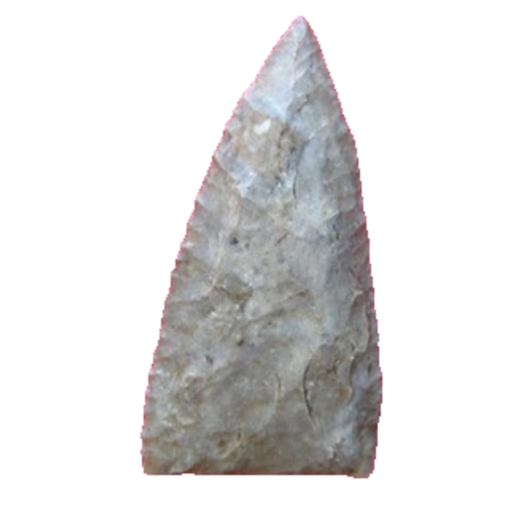
Arrowhead type
Early Triangular Point
Early Triangular9,000 - 8,000 B.P.Transitional Paleo to Early Archaic17 reference photos
Key facts
- Age
- 9,000 - 8,000 B.P.
- Cultural period
- Transitional Paleo to Early Archaic
- Size
- Medium to Large
- Shape
- Triangle
- Glacial period
- Early Holocene
Description
This triangular point exhibits a size range from medium to large, characterized by an elliptical profile in cross-section. Its blade morphology can vary, displaying either an excurvate or straight configuration. Notably, the edges of the blade often feature beveling in an alternating pattern, accompanied by serrations. The basal edge of the point can be either straight or concave, and it is typically thinned, sometimes displaying fluting or bearing long, narrow flakes that originate from the base. The flaking pattern observed on this point is distinctively parallel and oblique.
Size
The dimensions of the arrowheads are characterized by a total length ranging from 40 to 90 mm, with a mean length typically falling between 50 to 65 mm. In terms of width, the basal measurements span from 25 to 40 mm, averaging between 28 to 34 mm.
Distribution
This type is mainly located in the Pecos area and extends into south and central Texas. It can also be discovered in southern Oklahoma, albeit less commonly.
Additional information
In their 2012 publication, Bousman and Vierra explored a distinct temporal framework, initially outlined by Solberger and Hester in 1972, which is characterized as the "Pre-Archaic" period. This phase marks the culmination of the Transitional Paleo tradition, preceding the onset of the Early Archaic tradition. Notably, Bousman and Vierra propose that specific artifact types serve as diagnostic markers for this Pre-Archaic period. However, a significant body of literature contradicts this classification, instead situating these artifacts within the Early Archaic period.
A closer examination of these artifacts reveals intriguing functional implications. McGraw's 1984 theory suggests that these tools were utilized as knives, with their morphology evolving in response to the stage of use. This idea is supported by Turner and Hester's 1985 research, which highlights the dynamic relationship between tool form and function. The variability in shape, therefore, may be an indication of the tool's adaptive reuse, reflecting the resourcefulness and ingenuity of the individuals who crafted and employed these artifacts.
The classification and functional interpretation of these artifacts underscore the complexities of reconstructing the lives and technologies of past cultures. As archaeologists, it is essential to consider the nuanced and sometimes conflicting perspectives on the timing and use of these tools. By examining the intersections of artifact form, function, and cultural context, we can gain a deeper understanding of the Pre-Archaic and Early Archaic periods, ultimately enriching our knowledge of the rich and diverse cultural heritage of Native American communities.
Identified by
- Named by
- Thomas H. Hester
- Year
- 1971
Similar types
Types that are easy to confuse with the Early Triangular point.
Other types in this cluster
- Golondrina