
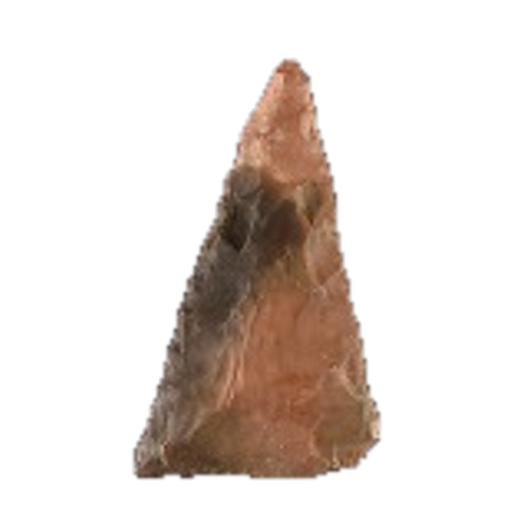
Arrowhead type
Scarem Point
ScaremLate Woodland Triangle Cluster to Early Mississippian Triangle Cluster950 - 375 B.P.MississippianKey facts
- Age
- 950 - 375 B.P.
- Cultural period
- Mississippian
- Size
- Small
- Shape
- Triangle
- Material
- Pottery
- Glacial period
- Medieval Warm to Little Ice Age
More from the Mississippian period
Description
This slender, triangular point measures between 0.5 and 0.75 inches in size, exhibiting a compressed cross-sectional profile. The blade's morphology is predominantly linear, although occasional specimens display an excurvate or, more rarely, an incurvate curvature. The point's overall shape typically conforms to an isosceles triangular configuration, where the width is roughly half the height, while a smaller subset of examples approaches an equilateral triangle, with width and height being approximately equal. The base of the point is generally characterized by a straight to subtly concave edge, often accompanied by basal thinning, which serves to reduce the point's thickness at its base. The flaking pattern observed on this point is random, lacking a discernible order or orientation.
Size
The overall length of the arrowhead ranges from 11 millimeters to 20 millimeters.
Distribution
This type is mainly located in southernmost western Ontario.
Mainly found in
Additional information
The classification of these arrowheads has sparked intriguing discussions among archaeologists. While some researchers propose that they may represent a northern extension of the Fort Ancient point type, a notable distinction lies in the absence of serrations on the blades, a characteristic commonly associated with Fort Ancient points. This discrepancy has led to alternative interpretations. Notably, Johnson (1992) has drawn a connection between these arrowheads and the Monongahela culture, based on the presence of low to medium collared pottery at associated sites. This has prompted the suggestion that these points may be an example of a northern intrusion of the Monongahela culture, potentially even constituting a distinct type known as the Monongahela point.
Further investigation has yielded additional perspectives on the origins and affiliations of these arrowheads. Fox (1981) has proposed an alternative theory, positing that these points may be a localized variation of the Nanticoke Triangular point, which emerged during the post-Middleport Horizon period. This hypothesis underscores the complexity and diversity of cultural influences in the region, highlighting the need for continued research and analysis to fully understand the context and significance of these artifacts.
The ongoing debate surrounding the classification and cultural affiliation of these arrowheads serves as a testament to the richness and intricacy of Native American archaeological record. As researchers continue to refine their understanding of these artifacts, it is essential to consider the multifaceted cultural landscape of the region, acknowledging the potential for overlap, exchange, and innovation among different groups. By examining the characteristics and associations of these arrowheads, scholars can gain valuable insights into the lives and traditions of the people who crafted and utilized them, ultimately enriching our appreciation for the history and heritage of Native American communities.
Identified by
- Named by
- William J. Mayer-Oakes
- Year
- 1954
Similar types
Types that are easy to confuse with the Scarem point.
- Daniels
- Fort Ancient
- Glen Meyer Tanged
- Monongahela
- Nanticoke Triangular
- Levanna
- Madison