
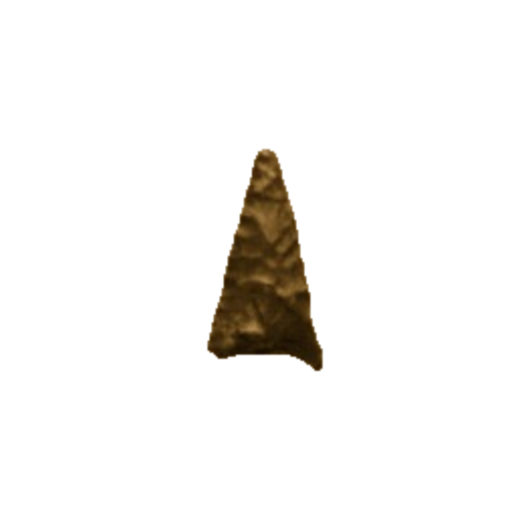
Arrowhead type
Glen Meyer Tanged Point
Glen Meyer TangedLate Woodland Triangle Cluster to Early Mississippian Triangle Cluster1,500 - 700 B.P.Late Woodland to Early MississippianKey facts
- Age
- 1,500 - 700 B.P.
- Cultural period
- Late Woodland to Early Mississippian
- Culture
- Early Ontario Iroquois
- Size
- Medium
- Shape
- Triangle
- Material
- Chert
- Glacial period
- Roman to Medieval Warm
More from the Woodland, Mississippian periods
Description
This triangular point exhibits a balanced proportions, measuring between 1.18 to 2.25 inches in size, with a shape that ranges from equilateral to isosceles, where the length can be up to twice the width. Its cross-sectional profile is elliptical, providing a distinctive silhouette. The blade's curvature is predominantly excurvate, although some specimens may display a slightly incurvate profile, often accompanied by asymmetrical features. The base of the point is characterized by a concave shape, giving rise to basal tangs, and in some cases, a single tang is present, reminiscent of the Glen Meyer Spurred type. The flaking pattern observed on this point is random, lacking a discernible order or organization.
Size
The dimensions of these arrowheads range from 30 to 59 millimeters in length, 16 to 27 millimeters in width, and 4 to 6 millimeters in thickness, as per the standards of the Ontario Archaeological Society - London Chapter.
Distribution
This type is mainly discovered across southern Ontario, ranging from the Niagara and Peninsula in the east to Lambton County in the west
Mainly found in
Additional information
More information needed.
Identified by
- Named by
- William C. Noble and W.A. Fox
- Year
- 1975
- Type site
- Glen Meyer Village, Bryant County, Ontario
Similar types
Types that are easy to confuse with the Glen Meyer Tanged point.