
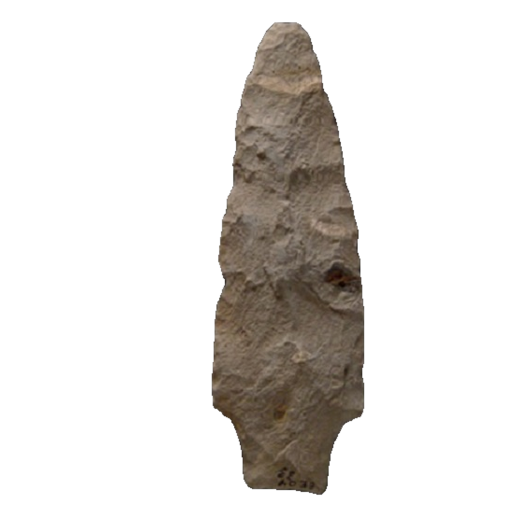
Arrowhead type
Satchell Point
SatchellGenesee Cluster5,100 to 3,163 B.P.Middle Archaic to Late Archaic7 reference photos
Key facts
- Age
- 5,100 to 3,163 B.P.
- Cultural period
- Middle Archaic to Late Archaic
- Culture
- Satchell Complex
- Size
- Medium to large
- Shape
- Straight Stem to Contracting Stem
- Material
- Argillite
- Glacial period
- Middle Holocene to Neoglacial
More from the Archaic period
Description
This triangular point exhibits a sturdy, medium to large size profile, characterized by a broad blade that displays a subtle curvature, ranging from excurvate to nearly straight. The cross-sectional shape is elliptical, providing a robust foundation for the point. The shoulders of the point demonstrate variability, with some examples showing an upward inclination, while others appear more horizontal. The stem is notably broad and rectangular in shape, featuring a base that is either straight or slightly concave, with basal corners that are subtly rounded. The flaking pattern observed on this point is random, lacking a discernible, organized arrangement.
Size
The arrowhead's dimensions are characterized by a total length ranging from 60 to 135 mm, with the stem section measuring between 16 and 20 mm in length. The blade itself spans a width of 25 to 47 mm, while the stem width falls within the range of 20 to 28 mm. In terms of thickness, the arrowhead measures between 7 and 12 mm.
Distribution
This type is mainly discovered in Michigan's Saginaw Valley and extends into adjacent areas of Michigan, northeast Indiana, northwest Ohio, and south Ontario
Also found, less often, in
Additional information
The initial classification of these arrowheads placed them within the Paleo to Early Archaic period, with a proposed timeline spanning from 7,000 to 4,000 B.C. However, this dating was largely inferred from stylistic similarities with other point types, such as Scottsbluff, Eden, and Hell Gap, as noted by Keynon in 1985. The majority of Satchell artifacts were recovered from surface sites, which limited the ability to establish a precise chronology. As a result, the temporal placement of these points was subject to debate, with some arguing that they represented a continuation of the "Broad Blade" complexes characteristic of the Middle Archaic period.
Radiocarbon dating has since provided a more secure basis for understanding the age of these artifacts. Analyses conducted at the Pinegrove Cemetery Site and the Fletcher Site, as reported by Emerson et al. in 2012, have yielded a revised temporal placement for the Satchell points. These findings indicate that the Satchell complex is more accurately associated with the Late Archaic period. This revised dating has significant implications for our understanding of the cultural and technological developments of the region during this time.
The reevaluation of the Satchell points highlights the importance of integrating multiple lines of evidence, including radiocarbon dating and stylistic analysis, to establish a robust chronology. The characteristics of these arrowheads, which were initially thought to be indicative of an earlier period, are now recognized as part of a distinct Late Archaic complex. This refinement in our understanding of the Satchell points underscores the complexity and nuance of the archaeological record, and demonstrates the value of ongoing research and reexamination in refining our knowledge of the past.
Identified by
- Named by
- Richard G. Peske
- Year
- 1963
- Type site
- Satchel Site, Saginaw Valley, Michigan
Similar types
Types that are easy to confuse with the Satchell point.
- Adder Orchard
- Alberta
- Eastern Stemmed
- Genesee
- Scottsbluff
- Stone Square Stem
Other types in the Genesee Cluster
- Koens Crispin
- Lehigh
- Snook Kill