
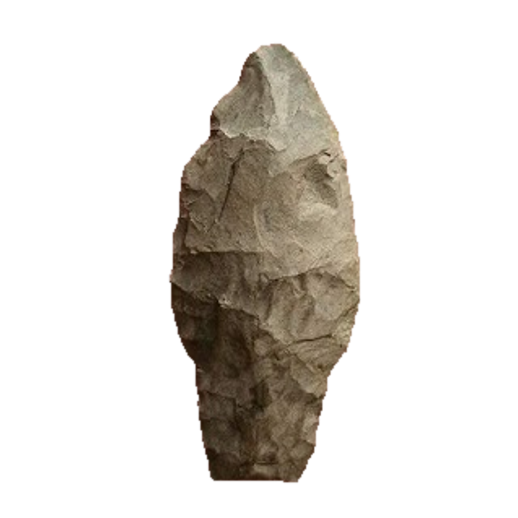
Arrowhead type
Adder Orchard Point
Adder Orchard3,300 - 2,000 B.P.Late Archaic to Woodland2 reference photos
Key facts
- Age
- 3,300 - 2,000 B.P.
- Cultural period
- Late Archaic to Woodland
- Size
- Medium
- Shape
- Straight Stem
- Material
- Chert
- Glacial period
- Neoglacial to Roman Warm
Description
This lanceolate point measures between 1.5 and 3.125 inches in length and features an elliptical cross-section. Its blade exhibits an excurvate profile, with the edges converging at the tip to form a parallel alignment. The blade's maximum width is situated just above the shoulders, which span approximately 0.75 to 1.5 inches. The shoulders themselves are typically subdued and angled upward. The stem, which accounts for roughly one-third to one-half of the point's total length (0.48 to 1 inch), is generally straight, although it may exhibit a slight contraction. The base of the point can be either straight or slightly concave. Notably, the hafting and basal areas often display light grinding. The manufacturing process involved initial broad, wide percussion flaking that covered both faces, followed by finer secondary pressure flaking along the edges, resulting in a random flaking pattern.
Size
The dimensions of these arrowheads are characterized by the following measurements: overall length ranges from 41 to 78 mm, with a mean length of 59.3 mm. The blade component spans 26 to 54 mm, averaging 40 mm. The stem section measures between 12 and 26 mm in length, with a mean of 17.4 mm. In terms of width, the shoulder varies from 19 to 38 mm, with an average of 28.4 mm, while the stem width falls within the range of 15 to 27 mm, averaging 22.7 mm. The thickness of these arrowheads is between 7 and 15 mm, with a mean thickness of 10 mm, as documented by the Ontario Archaeological Society - London Chapter.
Distribution
This type is mainly located in the Ausable Valley within the southeastern Hebron Basin in southwestern Ontario
Mainly found in
Additional information
In the realm of Native American archaeology, a specific type of arrowhead has often been misidentified as the older Stringtown points, commonly found in Ohio. However, research by Prufer and Baby (1963) has clarified that these points are, in fact, a distinct and younger type, dating back to the Late Archaic period. It is believed that this type of point evolved from the Genesee type, with the eastern variant developing a shorter, contracting stem, while the western variant, characterized by a longer stem and shorter, narrower blade, gave rise to the points in question, designated as W14.
Notable discoveries of similar points have been made at the Pinegrove Cemetery in Michigan, which has yielded radiocarbon dates of 1,060 B.C. and 1,355 B.C. (Simons, 1972). Additionally, a C-14 date of 1,900 B.C. from the Adder Orchard site has been deemed acceptable by Kenyon (1983). These findings suggest that these points represent a unique type, potentially related to the "Christmas Tree" points of the Satchell complex, as proposed by Kenyon (1980). Interestingly, the Adder Orchard points also bear similarities to the Springtown points found in Ohio, which have been mistakenly identified as Plano points in the past (Prufer and Baby, 1963). This highlights the importance of careful analysis and distinction in the classification of archaeological artifacts.
The study of these arrowheads provides valuable insights into the cultural and technological developments of Native American communities during the Late Archaic period. The evolution of point types, such as the transition from Genesee to W14, reflects the dynamic nature of prehistoric cultures, with regional variations and adaptations shaping the development of tool technologies. By examining these points in their archaeological context, researchers can gain a deeper understanding of the complex social and cultural dynamics at play in the lives of Native American communities, ultimately enriching our appreciation of their history and heritage.
Identified by
- Named by
- N. Ferris and I. Kenton
- Year
- 1966
- Type site
- Adder Orchard site, Ontario
Similar types
Types that are easy to confuse with the Adder Orchard point.