
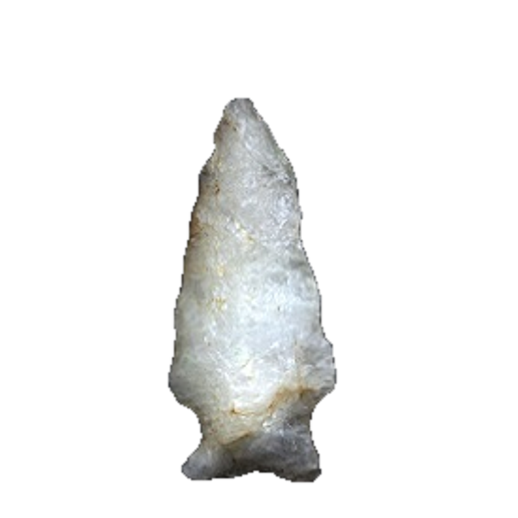
Arrowhead type
Clagett Point
ClagettLamoka Cluster4,500 - 3,500 B.P.Prehistoric to Historic5 reference photos
Key facts
- Age
- 4,500 - 3,500 B.P.
- Cultural period
- Prehistoric to Historic
- Size
- Small to Medium
- Shape
- Side Notch to Expanding Stem
- Material
- Quartz
- Glacial period
- Neoglacial
More from the Historic period
Description
This triangular point exhibits a robust profile, measuring between 1.7 and 3.46 inches in length, with a distinctive elliptical cross-section. The blade's curvature transitions from excurvate to straight, presenting a slender and elongated shape. The shoulders display variability, ranging from a horizontal orientation to a subtle upward incline. Characteristic parallel notches define the expanding stem, which terminates in a generally straight base. The flaking pattern on this point appears to be random, lacking a discernible order or sequence.
Size
The dimensions of the arrowheads are characterized by the following measurements: overall length ranges from 43 to 89 mm, while the stem length constitutes 15% to 20% of the total length. In terms of width, the arrowheads measure between 15 and 29 mm, with an average width of 22 mm. Notably, the stem width exceeds the stem length. The thickness of the arrowheads varies from 6 to 13 mm.
Distribution
This type is mainly discovered in upper Virginia and extending into Maryland.
Also found, less often, in
Additional information
In their 1963 publication, Stephenson and Ferguson proposed that a particular arrowhead type could be viewed as a variant of the Bare Island type, with a key distinguishing feature being the presence of an expanding stem, in contrast to the straight stem characteristic of the Bare Island type. Furthermore, they observed a notable resemblance to the Orient type, highlighting the complexities of typological classification in Native American arrowheads. Nearly three decades later, LeeDecker and Koldehoff (1991) offered an alternative perspective, suggesting that this type might be more accurately considered a variant of the Halifax/Vernon type, albeit one that is larger in size and often crafted from quartzite, thus expanding our understanding of the morphological diversity within these established types.
The observations of Stephenson and Ferguson, as well as those of LeeDecker and Koldehoff, underscore the challenges and nuances inherent in the classification of Native American arrowheads. The distinction between types, such as the Bare Island and the proposed variant with an expanding stem, or the potential affiliation with the Halifax/Vernon type, hinges on subtle differences in morphology, including stem shape and size. These variations not only reflect the technological and stylistic preferences of different Native American groups but also highlight the dynamic nature of cultural expression and tool manufacture across time and space.
The consideration of this arrowhead type as a larger, quartzite variant of the Halifax/Vernon type, as suggested by LeeDecker and Koldehoff, invites a closer examination of the material choices and technological strategies employed by Native American communities. The use of quartzite, a durable and versatile material, in the manufacture of these larger arrowheads may indicate specific functional requirements or cultural preferences, further enriching our understanding of the complex interplay between technology, environment, and cultural tradition in the production and use of arrowheads.
Identified by
- Named by
- Robert L. Stephenson and Alice L. L. Ferguson
- Year
- 1963
- Type site
- Accokeek Creek Site, Maryland
Similar types
Types that are easy to confuse with the Clagett point.
- Bare Island
- Brewerton
- Halifax
- Otter Creek
- Orient
- Vernon